
Feed wheat climbs as Black Sea exports collapse
Our benchmark spot prices (East Midlands)
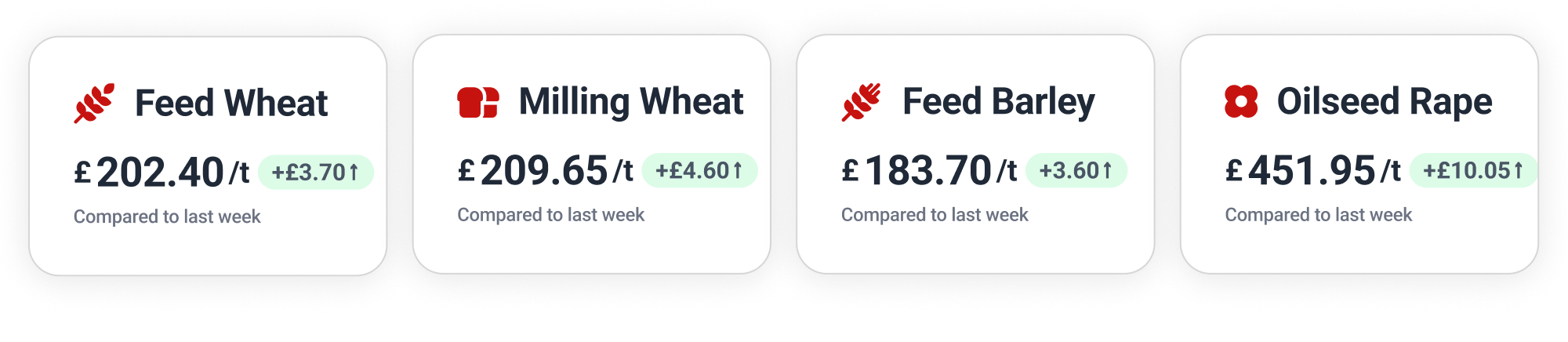
Feed Wheat
Global grain markets have transitioned into a highly volatile period driven by speculative buying and acute supply disruptions.
The Black Sea escalation has devastated exports. Russia’s August wheat export projections have plummeted to just 1.8–2.2 million tonnes (well under half of the five-year average of 4.8 million tonnes), while, with vessel traffic in Greater Odesa at a complete halt, Ukraine’s total grain exports fell by 76% year-on-year in the first two weeks of August.
London feed wheat has consolidated above the £200 mark this week. After giving up 25p on Monday and regaining that ground on Tuesday, the November 2026 contract moved ahead to £204.75 on Wednesday. Further gains on Thursday saw the contract hit a high of £207.50 before closing at £205.75.
For full spot and futures price analysis, visit our enhanced Insights on Hectare Trading.
Milling Wheat
Despite low yields in the UK, the quality of the harvested wheat is holding up well. According to AHDB, specific weights for group 1 milling wheat samples are exceptional, ranging from 76 to 85 kg/hl and averaging 82 kg/hl.
Protein levels are also high, averaging 13.5%. This abundant supply of high-spec milling wheat has the potential to restrain milling premiums over feed wheat.
Meanwhile, Romanian milling wheat export values have surged as importers seek a reliable supply corridor while military strikes disrupt deep-water ports in Russia and Ukraine.
The September 2026 Paris milling wheat contract dropped to €225.25 (£192.59) on Monday, then fell another €1 on Tuesday. After recovering to €227.25 (£194.54) on Wednesday, the contract broke through €230 in intraday trading before ending Thursday unchanged.
Feed Barley
Australia exported an impressive 9.7 million tonnes of barley in the first nine months of the 2025/26 season (comprising 7.74 million tonnes of feed barley) with shipments projected to approach a record 11 million tonnes by the end of September. China is the primary destination, accounting for 85% of export volumes in June.
Looking to the start of the 2026/27 marketing year, EU barley exports have by contrast disappointed. The EU has exported only 600 thousand tonnes of barley since the start of July – a massive threefold decline from the 2.12 million tonnes exported during the same period a year earlier.
Oilseeds
Germany’s winter rapeseed yields have plummeted by 20% this season to just 3.3 million tonnes, as the late-June heatwave triggered premature ripening during critical development stages, while severe pest pressure caused further extensive damage.
Canada’s canola harvest is just getting underway, but crops are facing widespread threats from fungal diseases, due to humid weather following the wet spring. Canada’s 2026/27 canola export forecast has therefore been trimmed to 7.6 million tonnes.
With Canadian supplies tight and Black Sea flows severely disrupted, importers are pivoting aggressively to Australian canola. Australia has exported 4.49 million tonnes of canola since October last year, with Belgium and Germany the main destinations.
Paris rapeseed futures made tentative gains before falling away on Thursday. The November 2026 contract rose to €549.00 (£469.40) on Monday and €551.75 (£472.34) on Wednesday, but a €7 fall brought the price down to €544.75 (£466.75) at Thursday’s close.
Wanted Crop
🌾 Group 1 wheat is wanted for collection in the East Midlands and Yorkshire and the Humber. Moving this month, with a guide price of £212–218/t ex-farm.
This article is for general information only and does not constitute advice. While we make every effort to ensure the accuracy of the content at the time of publication, Hectare Trading makes no guarantee regarding the data provided.