
What really sets the price of your oilseed rape?
3-MINUTE READ
When you look at your local price for oilseed rape (OSR), it’s easy to assume this is the result of regional economic forces. In fact, your price is often being shaped thousands of miles away – by trade talks, oil markets and currency moves that have little to do with UK supply and demand.
This week OSR has traded for £420/t or more ex-farm – before oil bonuses – marking a seven-month high. But what exactly has caused this?
On 4 February, President Trump suggested that China was preparing to buy an extra 8 million tonnes of US soybeans. Whether that figure was realistic – with major producer Brazil reaching its peak export season – didn’t really matter. The market reacted instantly.
Chicago soybean futures rallied hard, with the nearby contract jumping from 1060.25 cents/bushel on 3 February to 1115.25 cents/bushel on 6 February, and a further 22 cents/bushel by 12 February.
Paris rapeseed futures followed suit, climbing from €477.50/t on 3 February to €489.25 on 9 February.
This wasn’t a coincidence. Since October, when signs of a US–China trade deal first emerged, Paris rapeseed and Chicago soybeans have been virtually in lockstep.
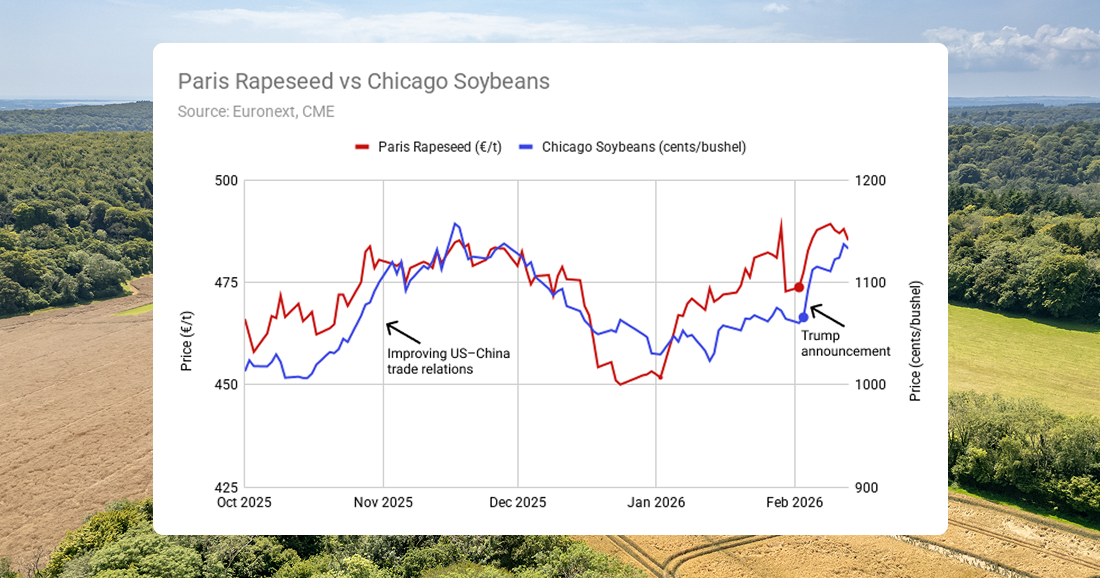
Comparing the nearby contracts of Paris rapeseed and Chicago soybeans, since October 2025
Why does that matter to you? Because buyers price UK OSR off Paris futures. If Paris is being pulled higher by Chicago soybeans, then the price you’re offered in the UK is, in effect, being at least partly determined by trade negotiations between Washington and Beijing.
The global oilseed complex
Oilseed rape is part of the global oilseed complex – a tightly linked system that includes soybeans, rapeseed, sunflower seed and their processed products.
According to the latest WASDE report, global oilseed production for 2025/26 is nearly 696 million tonnes, with soybeans accounting for over 428 million tonnes. Brazil alone produces around 180 million tonnes of soybeans making it the single biggest player in the market.
When Brazilian soybeans are cheap, they can drag down or cap prices across the entire oilseed complex, including UK OSR.
Why crude oil moves rapeseed
Another big external influence is crude oil. When crude oil moves, it often ripples through the entire oilseed complex.
One of the strongest links is in biofuel production. If crude oil prices rise, fossil diesel becomes more expensive, so biofuels become more competitive, which raises demand for vegetable oils used to produce biodiesel.
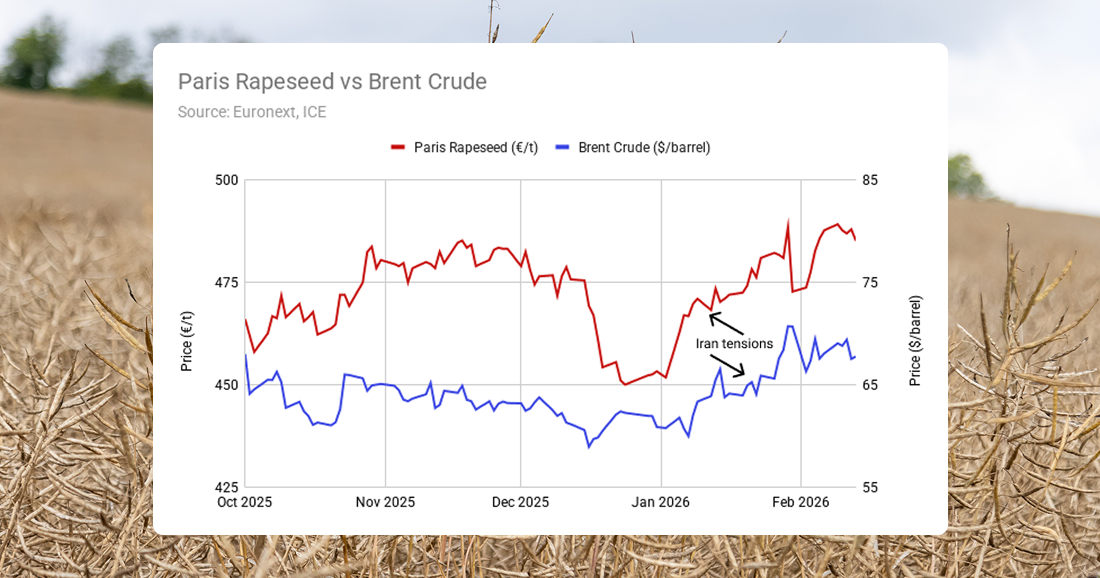
Comparing the nearby contracts of Paris rapeseed and Brent crude oil, since October 2025
Looking at Paris rapeseed and Brent crude oil since last October, we can see that, while the correlation of prices is weaker overall, there are key periods of influence.
Last month, for example, Iran’s brutal repression of public protests increased geopolitical tensions, with US military deployments in the Gulf.
As the threat of conflict risked disturbing oil production, Brent crude oil climbed more than 16% from $60.75/barrel on 2 January to $70.71/barrel on 29 January. Over the same period, Paris rapeseed jumped by over 8%, from €451.75/t to €488.50/t.
Don’t forget the exchange rate
Oilseed rape is traded internationally, so currency movements matter. This is especially important as the benchmark futures contract, Paris rapeseed, is priced in euros.
A weaker pound makes UK OSR cheaper for exporters, supporting prices
A stronger pound can cap domestic values
Whenever you use Paris futures as a benchmark, it makes sense to convert the price to sterling at the current exchange rate. This is exactly what buyers do when they price from the futures.
Over the second half of last year, the pound weakened against the euro, improving the relative competitiveness of UK OSR. So far this year the exchange rate has been more stable, but it remains an important piece of the pricing puzzle.
Factor in the oil bonus
When you’re posting OSR on Hectare Trading, remember that you’re trading on the base price, excluding any oil bonus.
Typically, the bonus is 1.5% of the contract price for every 1% of oil above 40%. On a £420/t base price, with an oil content of 46%, this would add 9% – or £37.80/t – to your final return which would total £457.80/t.
Global forces, local prices
UK OSR prices don’t simply reflect what’s happening in your field or your county. They’re shaped by soybean deals in China, harvests in Brazil, oil prices in the Middle East and currency markets closer to home.
Understanding those global signals won’t remove uncertainty, but it can help you judge when a price looks worth capturing, or when to sell forward to manage market risk.
In a market this interconnected, take note of how quickly global events can filter through to UK prices. That insight can make the difference between playing catch-up with the market and staying ahead of it when selling oilseed rape.
Check grain prices for your region on Hectare Trading. If you’ve got OSR to sell, try posting a listing to see what buyers are currently willing to pay.
This article is for general information only and is not an instruction to trade. While we make every effort to ensure the accuracy of the content at the time of publication, Hectare Trading makes no guarantee regarding the data provided.