
Why do quality crop homes fill up in December?
2-MINUTE READ
December can be a frustrating month for milling wheat and malting barley sellers. You’ve got grain in the shed, the bills are due and buyers who were accessible earlier in the season become slow to respond – or disappear entirely. So why does this happen, and what can you do about it?
Premium markets buy early
Flour millers and maltsters typically contract a large proportion of their supply well ahead of harvest. By December, their intake is already largely covered and only small “top-up” volumes are still needed.
This naturally reduces the number of active buyers on the spot market, tightening competition for grain-sellers. Those still in the market may only be looking for very specific quality bands or very small quantities.
This lack of demand is reflected in the market. Last year, spot milling wheat (ex-farm) dropped from £207.33/t on 11 November to £192.82/t by the end of the year (based on sales on Hectare Trading).
While UK prices were suppressed last year by abundant imports, AHDB Corn Returns indicate that milling wheat premiums also tightened over this year-end period.
When we compare the current year, we’ve already seen spot prices fall away from mid-November as milling premiums have similarly eroded.
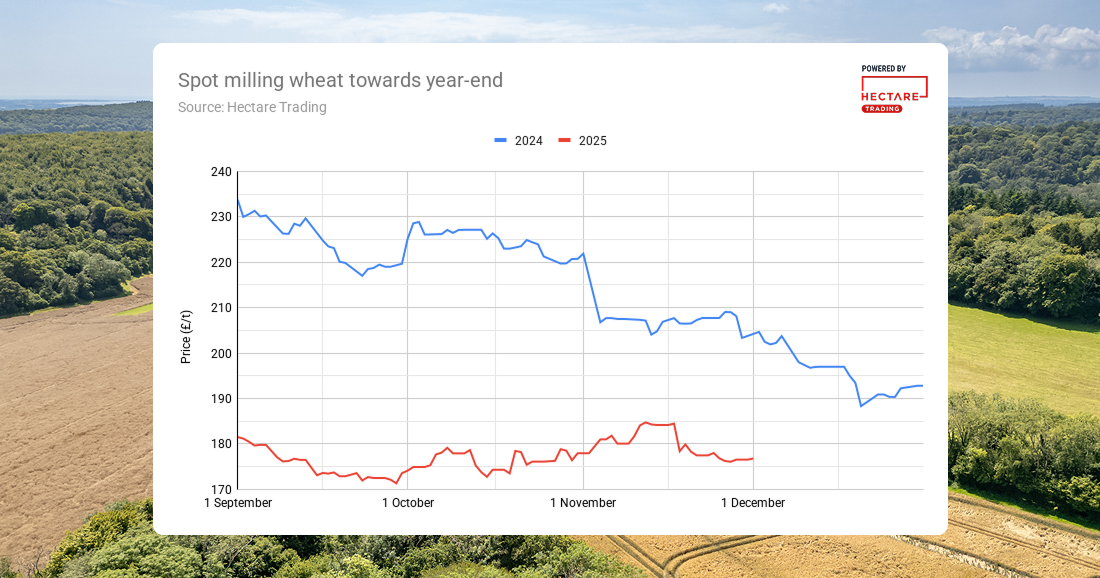
From mid-November to the end of the year, ex-farm spot milling wheat prices have declined in recent years
What’s more, quality-sensitive crops pose a higher risk later in the year. For instance, buyers know they are more likely to see reduced germination in malting barley.
And if supply does get short, millers and maltsters can always buy imported wheat and barley, as they did last year, reducing their reliance on late-season domestic spot purchases.
Logistics tighten before Christmas
December brings its own practical challenges too. Even when a buyer is willing, they may not be able to take more grain:
On-site storage is often at capacity
Haulage becomes harder to book over the Christmas season
Weather disruption can increase
Factories and mills may shut or slow down over Christmas
Buyers avoid making commitments they aren’t sure they can move, store or process. There is simply less appetite for spot buying, even at workable prices.
So what if you still have crop to sell?
If you can store your grain comfortably over Christmas, selling it forward may be a better option.
By late winter or spring, availability increases as intake capacity opens up and buyers are able to process more grain. The carry on forward contracts should also give you a healthier price.
Another tactic is to cast your net more widely. Even in December, some buyers will have room – you just need access to them.
Instead of ringing around dozens of merchants, using Hectare Trading you can get your grain in front of more than 100 buyers at once. You stand a better chance of finding someone with the capacity to take your grain, and competition between buyers might earn you an extra pound or two per tonne.
For buyers, the risks and practicalities of handling late-season grain often stack up against spot purchasing, but that doesn’t mean you’re stuck.
With smart timing, forward contracts and online selling to expand your buyer pool, you can find better homes – and better prices – for your quality grain, even when the market feels quiet.
Looking for active grain buyers in December? Post a free crop listing on Hectare Trading today and see what the market has to offer.
This article is for general information only and is not an instruction to trade. While we make every effort to ensure the accuracy of the content at the time of publication, Hectare Trading makes no guarantee regarding the data provided.