
How to choose your grain marketing strategy
3-MINUTE READ
What approach do you take to grain trading? Before you build out a detailed plan and selling schedule, it’s worth stepping back to think about your higher-level strategy – and whether it genuinely suits both your business and your personality.
There’s no single “right” way to sell grain. The best strategy for you will depend on factors such as:
Your attitude to risk
Your cash-flow constraints
Your storage capacity
Your interest in tracking the markets
Let’s take a look at four common grain marketing strategies and where each might fit in a UK arable business.
1. Reactive trading: timing the market
This approach is all about responding quickly to market movements. The reactive trader watches prices closely and tries to sell into rallies before they fade. If the price looks right, they may be happy to move a large proportion of tonnage in a single sale.
This strategy:
Carries a high level of risk – what do you do if the market keeps dropping?
Requires constant awareness of market movements
Relies on good timing – and (at least some) luck!
If you follow this strategy, you should accept that you won’t always sell at the top of the market.
You also need to have very few cash-flow or storage constraints, so you can hold on to grain when prices are low. Otherwise, you can end up becoming a forced seller at the wrong moment.
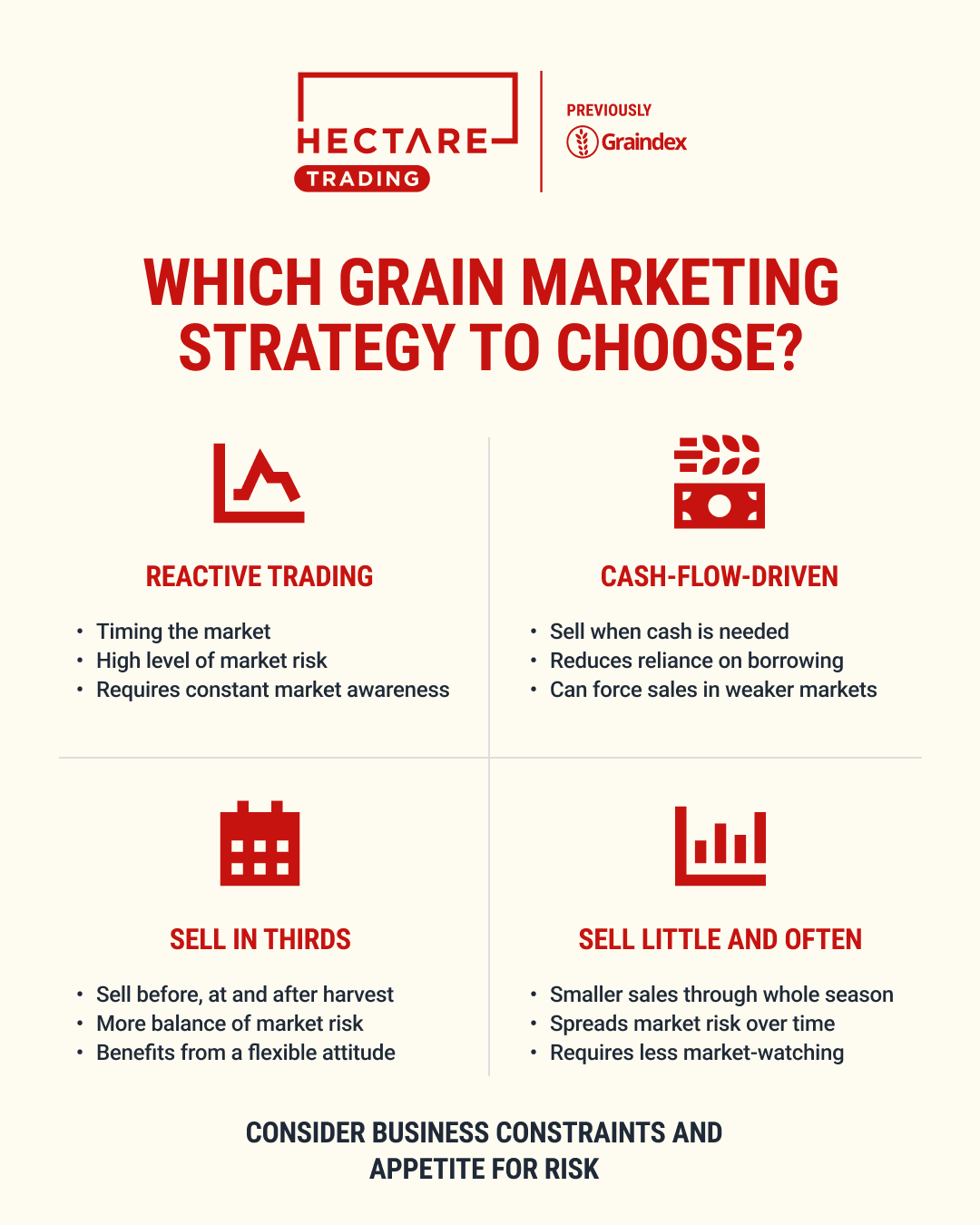
Your ideal strategy will depend on your appetite for risk, your economic conditions and your market awareness
2. Cash-flow-driven selling
For many farms, grain is sold when cash is needed: to pay rent or labour costs, buy inputs, service finance or meet tax bills. Price matters, but it’s not the only driver.
This strategy:
Works with a major real-world constraint: cash flow
Can reduce reliance on overdrafts and short-term borrowing
Might force grain sales in weaker markets
The primary concern here is keeping the farm business running smoothly, as the strategy aligns grain marketing with the farm’s financial calendar.
This can, and should, be used in conjunction with other approaches to optimise your average selling price while still keeping a clear eye on your business’ cash needs.
3. Selling in thirds
This is a structured, risk-spreading approach. The harvest year is divided into three periods: before harvest, at harvest and after harvest. Roughly one third of total tonnage is sold in each window.
This strategy:
Involves less tolerance of market risk
Avoids relying on a single point in the market
Benefits from a flexible attitude
As this approach is built around the harvest calendar, it can readily be aligned with storage and cash-flow demands, for example, the need to pay for inputs or to clear the sheds before harvest.
If you opt for this strategy, ask yourself: what will you do if you haven’t sold a third of your grain within a given period? Some growers stick rigidly to the structure. Others give room to adapt, if their constraints will allow.
4. Selling little and often
This approach focuses on managing risk over the whole season rather than predicting price peaks. Smaller amounts are sold regularly throughout the harvest year – sometimes even before seed is in the ground.
Performance is judged by the average selling price across the entire crop, not individual trades.
This strategy:
Spreads market risk over time
Requires more individual trades
Needs less constant market-watching or prediction
For many arable farmers, this is a disciplined and lower-stress way to trade, provided records are kept up to date and targets are clear.
Again, this strategy can be combined with elements of the other strategies to optimise your average price and ensure cash needs are met.
Putting strategy into practice
Choosing a strategy is one thing. Sticking to it across different crops and harvest years is another. Following any strategy depends on accurate tracking of sold and unsold tonnage.
Hectare Trading’s latest feature, Crops, lets you monitor your trading separately for each crop and each harvest year, helping you turn strategy into action.
You can clearly see:
How much tonnage you’ve sold and what remains unsold
Your average selling price on sold tonnage
The price you need to hit on remaining sales to meet your target
That visibility makes it far easier to stay disciplined – whether you’re selling in thirds, little and often or responding to market moves.
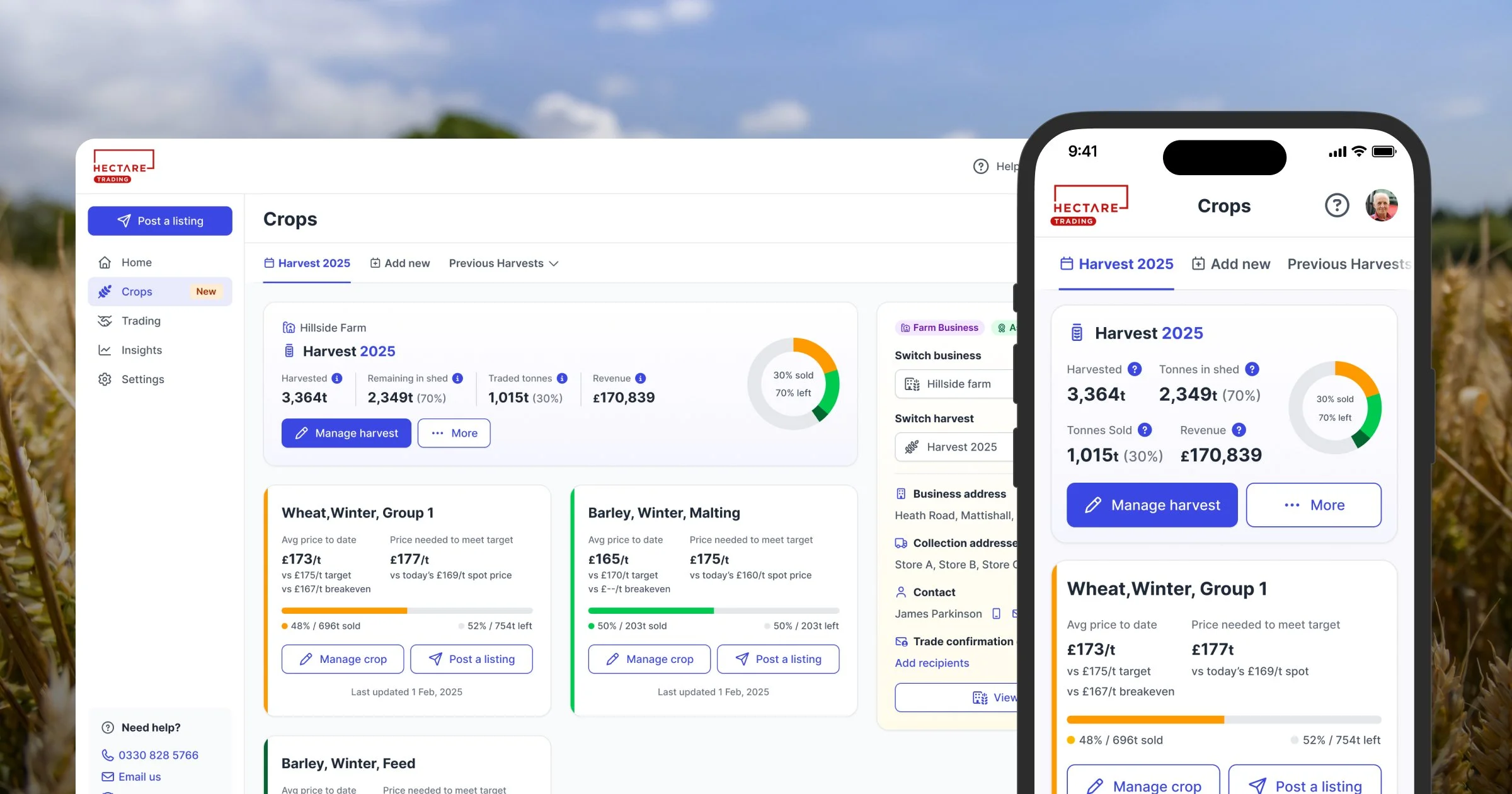
Crops gives you a real-time view of your trading progress per crop for each harvest year
Choose what works for you
The best grain marketing strategy is the one you can follow consistently. It should fit your appetite for risk, your business constraints and the amount of time you want to spend watching the markets.
This is a matter of assessing both your economic situation and your own personality. But if you take the time to get your strategy right, you can ensure that your grain marketing is always guided by your fundamental goals.
Check out the new Crops feature from the left-hand menu in Hectare Trading. Whatever strategy you follow, it can help you keep track of your trading progress.
This article is for general information only and is not an instruction to trade. While we make every effort to ensure the accuracy of the content at the time of publication, Hectare Trading makes no guarantee regarding the data provided.