
Tight UK wheat supply supports prices despite September slide
Our benchmark spot prices (East Midlands)
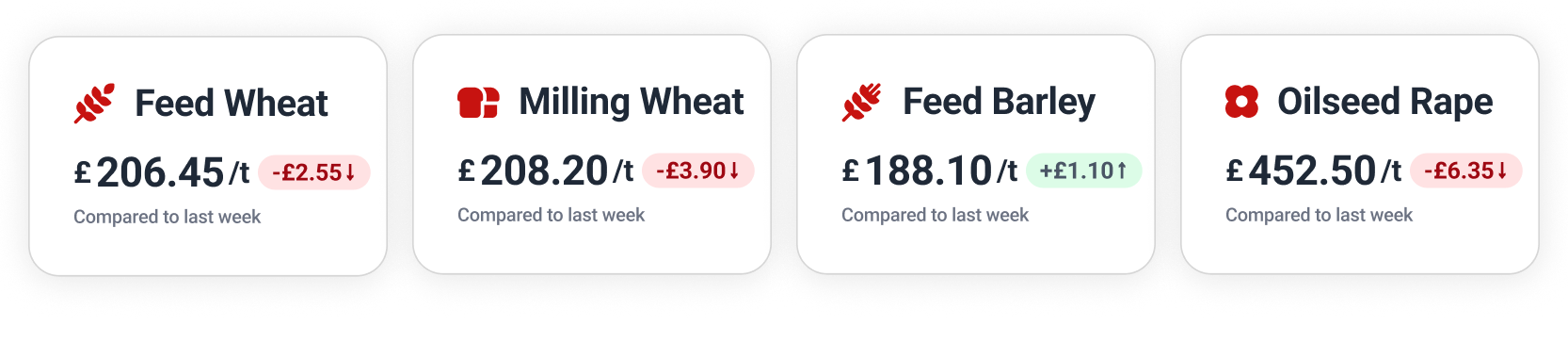
Feed Wheat
UK feed wheat futures retreated across September but still remain above £200 on supply concerns.
In the UK, final harvest data showed wheat yields 11% below the five-year average, keeping total production under 12 million tonnes for a third straight year.
Strong El Niño conditions continue to raise crop risks across Australia and South Africa, where wheat production is expected to fall to an eight-year low.
After hitting £219.25 early in September, November 2026 London feed wheat has been on a slow decline, ending Monday nearly £16 lower at £203.50. With a lack of impetus, the contract finished the month at £204.00, before climbing to £205.25 at Thursday’s close.
For full spot and futures market analysis, check our Insights on Hectare Trading.
Milling Wheat
Despite lower yields this year, UK Flour Millers report that milling wheat quality is encouraging, with sufficient supplies meeting millers’ specifications.
However, high fertiliser prices – UK-produced ammonium nitrate now averages £471.90 per tonne – are increasing pressure on UK growers aiming to make spec in 2027.
Hikes in diesel and transport costs have also made hauling milling wheat over long distances unviable, as freight costs erode the small premium over local feed sales.
Paris milling wheat futures started the week on the back foot, the December 2026 contract falling to €233.25 (£200.09) on Monday. After recovering €3 on Tuesday, the contract eased back to €236.00 (£201.69) on Wednesday, then moved ahead to €239.00 (£203.46) on Thursday.
Feed Barley
The Irish Grain Growers Group warned that malting barley risks becoming less profitable than spring feed barley due to higher production risks, potential crop rejections and grain handling charges.
Ukraine’s barley exports reached 431,000 tonnes by late September, running 45% behind last year’s pace due to Black Sea port disruptions and priority given to oilseeds.
Chinese buyers have been sluggish in purchasing Australian new-crop barley compared to last season, opting to draw down existing stocks or use alternative feed grains.
Oilseeds
Following the US–China summit, Beijing agreed to lower import tariffs on US agricultural products, although US soybeans were explicitly excluded and remain subject to an additional 10% duty. A lack of purchasing commitments also put downward pressure on US soybean prices.
Meanwhile, France is experiencing its worst soil drought on record, with winter rapeseed acreage expected to fall by 10–15%.
In the UK, 74% of OSR acreage is situated in regions currently classified as moderate-to-high drought risk areas, raising long-term supply concerns.
Paris rapeseed futures continued their recent choppiness this week. The November 2026 contract gave up €11.50 to close Monday at €536.50 (£460.24), then recovered to €544.25 (£466.52) on Tuesday before sinking back to €536.75 (£458.72) on Wednesday. Thursday’s trading saw the contract finish at €538.25 (£458.22).
Wanted Crop
🌾 Feed oats required for collection from Yorkshire and the Humber, the East Midlands and the East of England, for a Lincolnshire home. Movement between October and November 2026, with a guide price of £140–153/t ex-farm.
This article is for general information only and does not constitute advice. While we make every effort to ensure the accuracy of the content at the time of publication, Hectare Trading makes no guarantee regarding the data provided.