
Our benchmark spot prices (East Midlands)
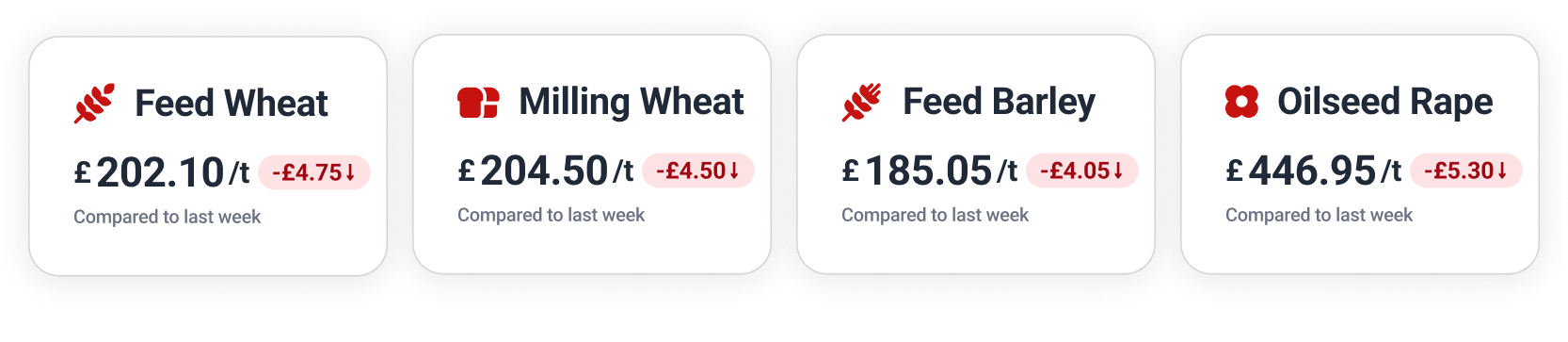
Feed Wheat
Uncertainty surrounds Russia’s willingness to enter peace talks with Ukraine or support proposals for a safe civilian navigation corridor in the Black Sea. After repeated drone attacks on cargo ships, NATO has increased its presence in the Black Sea.
Meanwhile, a key structural driver for European feed wheat demand is the disastrous French grain corn harvest, where drought cut yields to 6.3 t/ha and halved total production. High French corn prices are forcing substitution of corn with feed wheat across Western Europe.
Despite this rise in demand, London feed wheat futures have come under pressure this week. With consecutive losses on Monday and Tuesday, the November 2026 contract closed at £200.75, the May 2027 contract at £213.50. Having held above £200 since mid-August, the November 2026 contract then sank to £195.50 on Wednesday, and finished Thursday at £193.50.
For full spot and futures market analysis, check our Insights on Hectare Trading.
Milling Wheat
Egypt’s state grain buyer has tightened import quality rules by mandating a minimum 160W baking-strength rating. This spec change directly targets lower-quality Bulgarian and Black Sea wheat that suffered from weak dough and gluten network issues this season, effectively narrowing sourcing options in favour of higher-quality milling origins.
Italian pasta producers are meanwhile struggling due to trucking blockades restricting delivery of wheat and semolina, raising concerns that this could trigger shutdowns of flour mills. The logistical disruption has already led to retail shortages across southern Italy, prompting panic-buying of flour.
After closing last week at €243.75 (£205.69), the December 2026 Paris milling wheat contract slipped to €241.50 (£202.93) by Tuesday’s finish. A fall of €8.75 on Wednesday brought the contract down to €232.75 (£195.10), before a slight recovery to €234.25 (£196.10) on Thursday.
Feed Barley
Australia is set to harvest a record barley crop. The USDA projects Australian production at 17.1 million tonnes, up from last year’s record of 16.3 million tonnes, due to conducive weather conditions in southern and western Australia. With Black Sea logistics constrained, Australia is dominating barley trade into South East Asia and the Middle East.
Canada harvested a solid 9.7 million tonnes of total barley this year, but late-summer rains caused widespread pre-harvest sprouting. Less than 2 million tonnes met malting specifications (down from 3 million tonnes last year), pushing large volumes of sprouted grain into feed markets.
Oilseeds
Severe heat and prolonged summer drought across Western and Central Europe have cut total EU rapeseed production by 5% year-on-year to 19.7 million tonnes. To cover processor demand, total EU oilseed imports are now projected to rise by 7% in 2026/27.
Canada supplied 121,700 tonnes of canola to the EU in July to September this year, up from virtually zero last year, although the high prevalence of GM varieties restricts Canadian canola primarily to European biofuel processing rather than food supply chains.
Australian rapeseed exports to the EU also rose by 35% to 185,100 tonnes. However, rising ocean freight costs are capping further expansion.
Paris rapeseed futures continued to decline this week, the November 2026 contract sinking back through €500 to €493.25 (£415.34) on Monday. Following a small gain on Tuesday, the contract dropped again to €485.75 (£407.18) on Wednesday. Some respite, however, came on Thursday, the contract closing €12 higher at €497.75 (£416.71).
Wanted Crop
🌾 Group 1 wheat is wanted for collection in Yorkshire and the Humber and the East Midlands. Movement this month with a guide price of £206–212/t ex-farm.
This article is for general information only and does not constitute advice. While we make every effort to ensure the accuracy of the content at the time of publication, Hectare Trading makes no guarantee regarding the data provided.