
3-MINUTE READ
Holding harvested crop without securing a price is a gamble. You are exposed to falling markets – and forgo any potential benefit of market carry – while your storage costs continue to mount.
At harvest, it can be tempting to put grain into the shed and wait, hoping for market moves late in the year. Whether storing on-farm or using a commercial store, the thinking is familiar: hold off selling now and aim for a better price later.
But there is a hidden hazard in this approach. If you store grain without locking in a forward price, you’re paying to hold your crop while missing out on the financial gain of market carry. If the spot price then falls, you face a double penalty: the cost of storage and a lower crop value.
Banking on a late rally?
Looking at the nearby UK Feed Wheat futures contract from 2016 to 2025, prices rose between the start of October and the end of December in five years, and fell in the other five.
The exceptional market conditions following Russia’s invasion of Ukraine made 2022 an unusual year, as prices retreated from their earlier peak. But even allowing for that period, the figures show no structural pattern of prices rising during the final quarter of the calendar year.
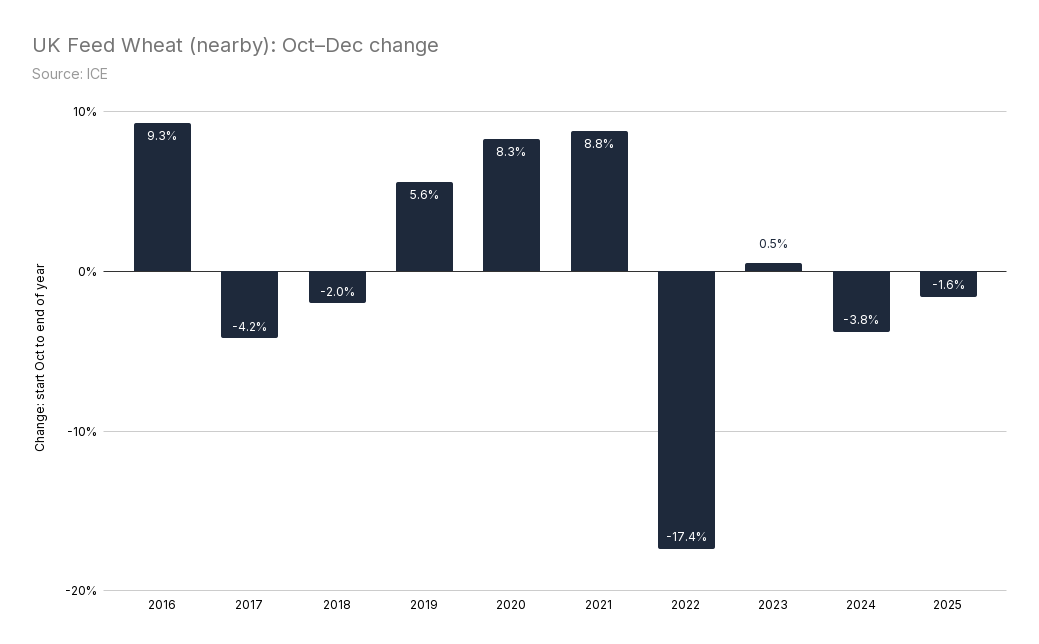
There is no recent pattern of price rises from the start of October to the end of year
In fact, across the 10-year period, the average price movement was a fall of £1.63/t. For a grower holding 1,000 tonnes of unpriced wheat, this would mean a £1,630 reduction in crop value – before accounting for any storage expenses incurred along the way.
Of course, historical averages do not predict what will happen this season. Prices could rise, and holding grain unpriced may turn out to be the right decision. But a winter rally is only a possibility, not a dependable marketing strategy.
The storage equation
Storage ties up capital and creates costs that need to be recovered.
Market carry – the premium available for selling grain for a later delivery period rather than an earlier one – provides a way to cover these costs and potentially increase the overall return on your grain.
If you leave crop unpriced instead, your eventual selling price must do more than beat today’s spot price. It must also compensate you for the cost of holding the crop and the carry you could have locked in.
With the current carry between the November and May UK Feed Wheat contracts of £13.50, that’s £2.25 per tonne lost for every month the grain stays unpriced. Enough to cover typical storage costs of £0.60 per tonne and give you a profit of £1.65 per tonne per month.
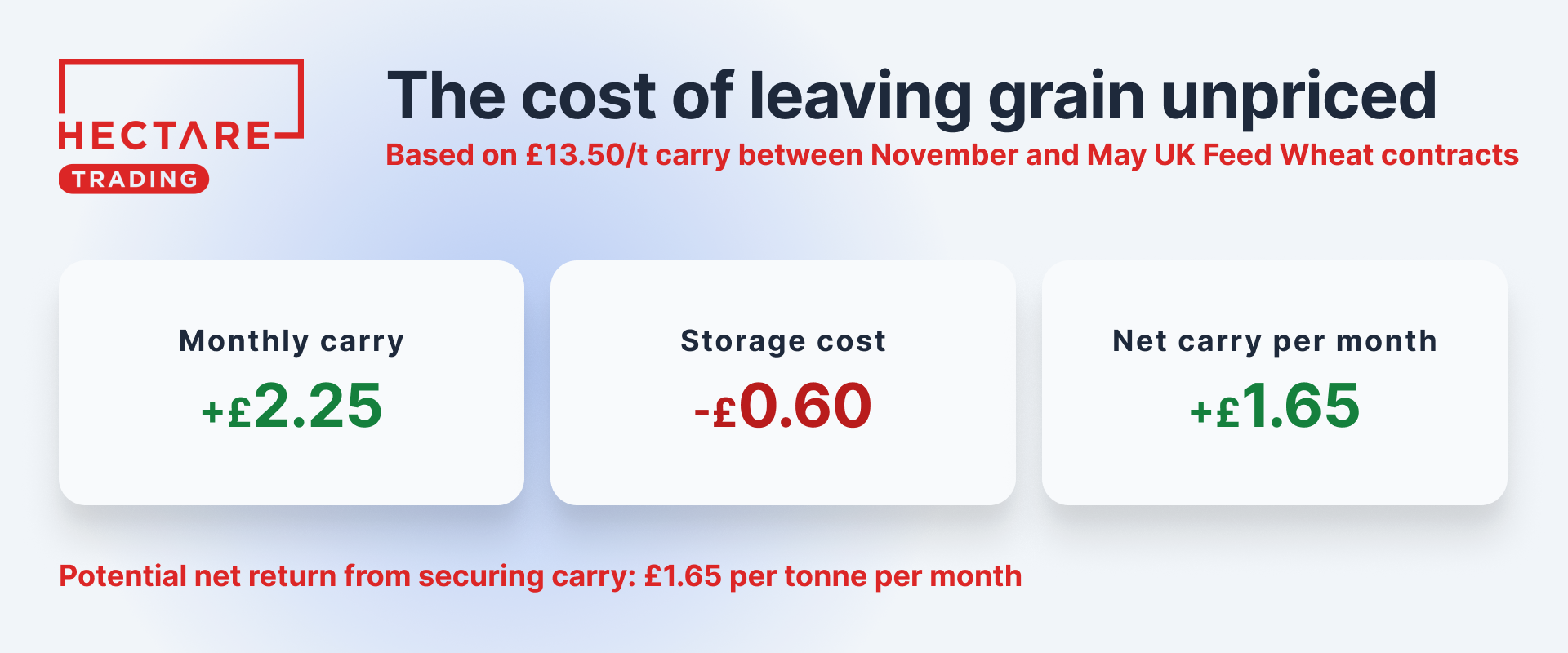
By leaving grain unpriced you miss out on potential carry
The worst-case scenario is that you incur storage costs, miss out on available market carry and eventually sell for less than you could have achieved in the spot market three months earlier.
How to avoid the double penalty
The solution is not necessarily to sell everything at harvest. It is to make sure that storage and marketing decisions work together.
Compare your monthly storage cost with the carry available for different delivery periods. If the premium exceeds your total cost, securing it through a forward contract turns storage into a more predictable financial decision.
You can also take a mixed approach. Forward-selling a portion of your crop allows you to lock in carry and establish future revenue, while keeping a smaller unpriced reserve gives you flexibility to respond if regional demand strengthens or the wider market rallies.
That way, you are not relying entirely on a price recovery to make storage worthwhile.
Three choices when you’re holding grain
If you have grain in store, there are three broad options to consider:
1. Sell now to move now
Convert the crop into cash, improve liquidity and avoid further storage costs. This may be the right choice if the available price meets your marketing objectives or the economics of holding no longer stack up.
2. Sell now to move later
Use a forward contract to lock in a price for future delivery. Where the available carry is sufficient, this can help cover storage costs and provide greater certainty over future income while the grain remains in store.
3. Hold the crop unpriced
Retain the opportunity to benefit from a price rise, but accept the risk that prices may fall. You also forgo any carry you could have secured through a forward sale, while storage costs continue to accumulate.
None of these choices is right for every farm or every season. The best option depends on your cash-flow requirements, storage costs, local demand and view of the market.
The important thing is to recognise what you are choosing – and what that choice costs. Leaving crop unpriced is effectively a bet on future prices, with the potential for a double penalty if the market falls and available carry goes unclaimed.
Compare recent trades and monitor local market prices on Hectare Trading. Post a free crop listing for future movement and see if you can lock in a price for your stored grain.
This article is for general information only and does not constitute advice. While we make every effort to ensure the accuracy of the content at the time of publication, Hectare Trading makes no guarantee regarding the data provided.