
Harvest 2026: record pace, falling yields
3-MINUTE READ
Harvest 2026 has moved at a remarkable pace. But while the combines have been busy, the early yield figures have given UK farmers little to celebrate. With wheat production in particular falling short of spring projections, how should farmers respond?
The UK has endured its driest July since records began, on top of heatwaves in May and June, and the impact on UK arable farms has been considerable.
According to AHDB figures, by 27 July the UK harvest was further progressed – across all major crops – than at the same point in any of the past eight years.
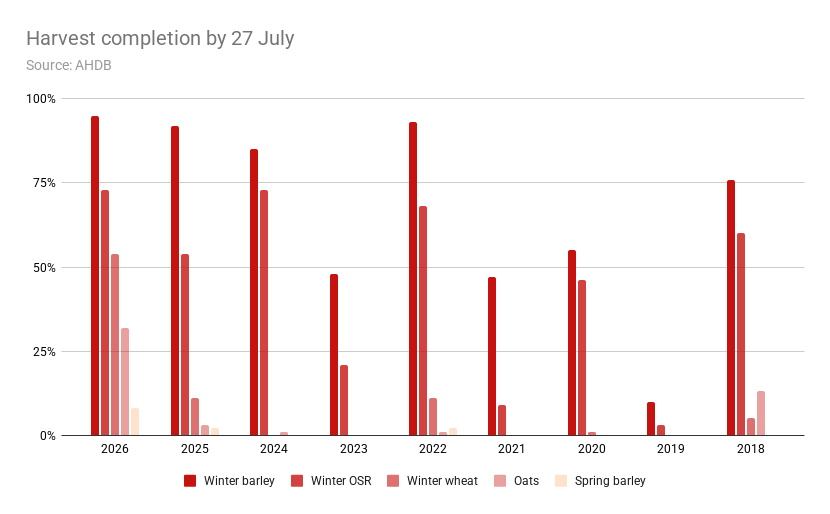
Harvest progress across major crops
Wheat has been especially fast, at 54% completion on 27 July. The next fastest was just 11% at the same point.
Unfortunately, the increased pace is matched by an alarming decline in yields.
Wheat yields close to historic lows
AHDB’s early estimate puts the average UK wheat yield at 6.8 t/ha, down from last year’s final average of 7.2 t/ha.
That in itself was a third successive decline from a peak of 8.6 t/ha recorded in 2022 – we are falling from an already weak baseline.
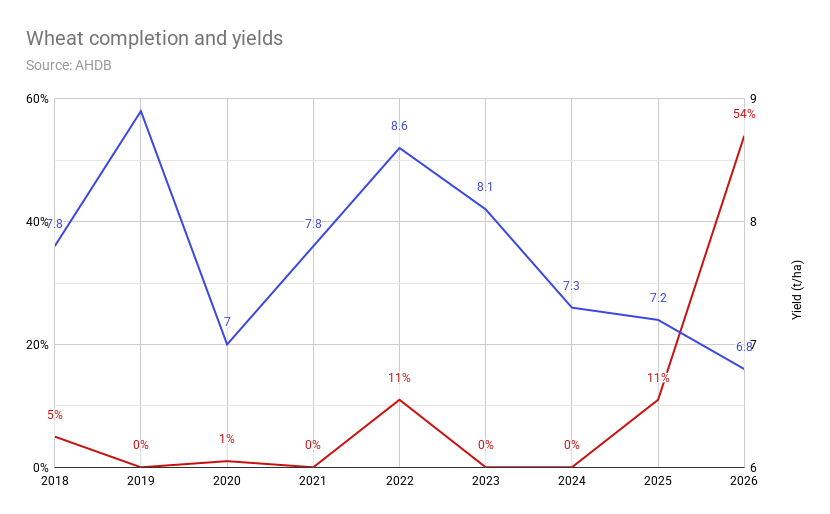
Wheat harvest progress is matched by a decline in yields
In fact, if we look further back, we can see just how poor the current wheat estimates are.
Since 1990, only twice before has the average UK wheat yield dropped below seven tonnes. And only once has the yield been lower than the current estimate – in 2012, when persistent heavy rainfall in spring and summer delayed harvest and yields fell to 6.7 t/ha.
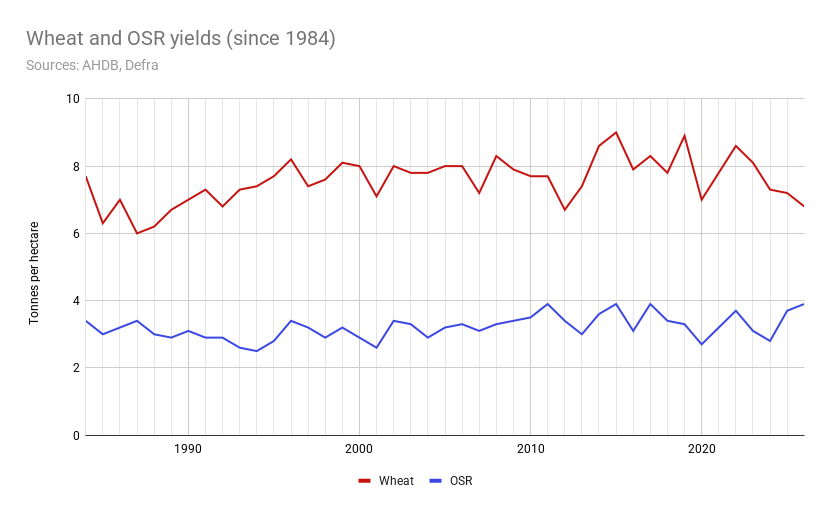
Wheat estimates are testing historic lows while OSR is testing highs
The national figure also hides some marked variation. AHDB reports wheat yields ranging from 3.9 to 11.5 t/ha – soil type appears to be a major factor, with crops on moisture-retentive soils generally better able to withstand the prolonged dry conditions.
However, it’s worth noting that only one in ten farms are reporting yields higher than their own five-year averages. Almost everyone is struggling.
That matches what we’re hearing through the Hectare Trading Harvest Reports and from Andrew Huxham’s arable farm in West Sussex. Last week, Andrew revealed that his winter wheat had come in at 6–7 t/ha against a potential yield of 10 t/ha.
This is particularly hard for farmers to take given that, due to the wet winter, crop projections were promisingly healthy in the spring.
The Energy and Climate Intelligence Unit is now forecasting a UK cereal and oilseed harvest of just 19.5 million tonnes, potentially making this one of the lowest harvests on record.
Bright spots: OSR yields and wheat quality
As it did last year, oilseed rape is bucking the general production trend.
Following on last year’s improvement in OSR yields, this year we’re seeing another rise to 3.9 t/ha, based on 73% completion.
If this is maintained through the rest of harvest, it would match the highest OSR yield Defra has on record. With OSR planting having increased by 49% this season, we could be looking at a large jump in overall production.
Another bright spot has been wheat quality. Across our Harvest Reports, it is generally agreed that quality has held up much better than yields.
AHDB likewise notes that specific weights for group 1 wheat have mostly been above 82 kg/hl, while average protein is around 13.5%.
Making the most of a smaller crop
If you've produced 20% less wheat than expected, finding an extra few pounds per tonne on the grain you do have becomes increasingly important to the bottom line.
That means taking advantage of better prices when they arise.
On Hectare Trading, we’re seeing by far the best prices on feed wheat we have for the past year – our benchmark East Midlands price is consistently hovering around £200 per tonne.

Taking more control of your grain marketing can also help turn a poor harvest into better returns. With our new Hectare Membership package, you can:
Get access to county-level prices and 14 days of Hectare trades
Track all your movements and payments to manage your cash flow
Receive a tonnage bonus on crop you sell through Hectare
No one knows where the market will go next. But you do have control over how and when you sell – so make every tonne count.
Want to find out how much you can get for your grain? Post a free crop listing to see what buyers are paying in your region.
This article is for general information only and does not constitute advice. While we make every effort to ensure the accuracy of the content at the time of publication, Hectare Trading makes no guarantee regarding the data provided.