
UK wheat yields slump as harvest disappoints
Our benchmark spot prices (East Midlands)
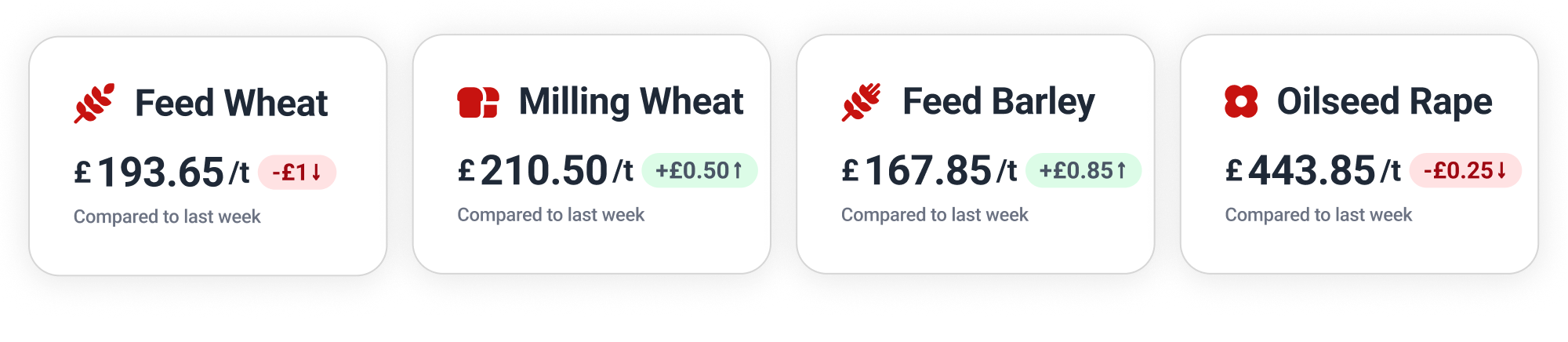
Feed Wheat
The physical reality of the UK harvest has set in. With the winter wheat harvest passing the halfway mark, AHDB average yields are sitting at 6.8 t/ha – a stark 13% decline against the five-year average, itself a weak benchmark after recent poor harvests.
The Energy and Climate Intelligence Unit warned that the heatwaves and lack of rainfall could reduce the UK harvest by up to 2.5 million tonnes to 19.5 million tonnes, surpassing 2020 as the worst harvest on record since detailed records began in 1984.
Meanwhile, hostilities in the Black Sea have intensified dramatically. Last weekend, Russia and Ukraine traded strikes targeting critical export and energy corridors, and alternative grain routes bypassing Odesa will not be able to make up for lost sea exports.
Despite the disrupted supply picture, London feed wheat futures have struggled to make ground this week. The November 2026 contract inched up to £198.75 on Monday, fell back on Tuesday, recovered to £198.25 on Wednesday, then finished Thursday at £197.50.
For full spot and futures price analysis, visit our enhanced Insights on Hectare Trading.
Milling Wheat
While UK volume is disappointing, the quality is exceptional. Milling specific weights are ranging from 76 to 85 kg/hl (mostly above 82 kg/hl) and group 1 proteins are averaging from 13.5% to over 14%.
However, the intense heat has dried out the grain, leaving moisture contents exceptionally low, averaging 11.9% compared to 14.3% last year. Brittle straw has increased combine wear and field fire risks.
As yields fall across EU-member countries, the European Commission has officially revised the 2026/27 EU soft wheat production forecast down to 124.4 million tonnes, 8% below last season.
Since closing at €244.25 (£208.44) on 22 July, September 2026 Paris milling wheat weakened steadily to €222.75 (£190.61) by the end of the month. After recovering slightly to €225.75 (£193.32) on Monday, the contract struggled through the rest of the week, closing Thursday at €219.75 (£188.17).
Feed Barley
The European Commission has similarly cut its EU barley production estimate to 51.05 million tonnes, from 55.6 million tonnes last season. Arid conditions have particularly affected the Spanish barley crop, which has collapsed to 6.4 million tonnes, from 9.1 million tonnes last year.
Widespread supply tightness has caused trade volumes to plummet. Since the start of the 2026/27 season, EU barley exports have collapsed by an incredible 82% year-on-year to just 310,000 tonnes.
Oilseeds
The global oilseed complex came under pressure towards the end of last week from falling crude oil values – which dropped on US–Iran de-escalation rumours – improved rain forecasts across the US Midwest and favourable crop conditions on the Canadian Prairies.
Confusion continues to surround the US–Iran peace negotiations, as Qatar claims an agreement is close but no direct talks are planned. Crude prices remain on a hair trigger for any rumours of a deal.
After falling over €14 to €513.00 (£438.99) last Friday, the November 2026 Paris rapeseed futures contract rebounded to €523.50 (£448.29) on Monday. Choppy trading through the rest of the week saw the contract drop nearly €5 on Tuesday, regain €523.50 (£448.74) on Wednesday, then climb on Thursday to €526.25 (£450.63).
Wanted Crop
🌾 Group 1, group 2 or group 4 hard wheat (10.2/74/130) is wanted for collection in the East Midlands, for movement this month. Guide price of £190–195/t ex-farm.
🌾 Group 1 wheat (13/76/250) required for collection in Yorkshire and the Humber. Moving in August, with a guide price of £200–206/t ex-farm.
This article is for general information only and does not constitute advice. While we make every effort to ensure the accuracy of the content at the time of publication, Hectare Trading makes no guarantee regarding the data provided.