
Many UK arable farms still follow the familiar rhythm of selling most of their grain between harvest and Christmas. It’s a pattern that feels comfortable – stores are full, cash is needed and the market can feel active.
But if you’re only marketing your crop inside that narrow four-month window, you could be missing valuable opportunities. Prices move all year round, and a broader, 12-month or even 24-month approach to selling can help spread risk and improve your long-term returns.
Little and often beats waiting for perfection
Grain markets don’t behave on a tidy seasonal cycle. Weather scares, geopolitical events, global demand and currency shifts can move prices sharply at any time of year. If you only sell in autumn, you’re tying the fate of the business to a very short period of market behaviour.
Spacing your sales across the full year – rather than sitting tight and hoping for the perfect price – helps smooth out volatility and reduces the pressure of relying on a single “selling season”. The earlier you start (even before your seed is in the ground), the more opportunities you have to pick off good prices.
Forward contracts, including feed base plus premium contracts for quality crops, let you secure margin when the market hits a level you’re comfortable with. They’re a useful tool for taking risk off the table at moments when supply and demand are working in your favour.
And crucially, you remain in control. Early marketing doesn’t force you to commit large volumes – just steady, measured tranches.
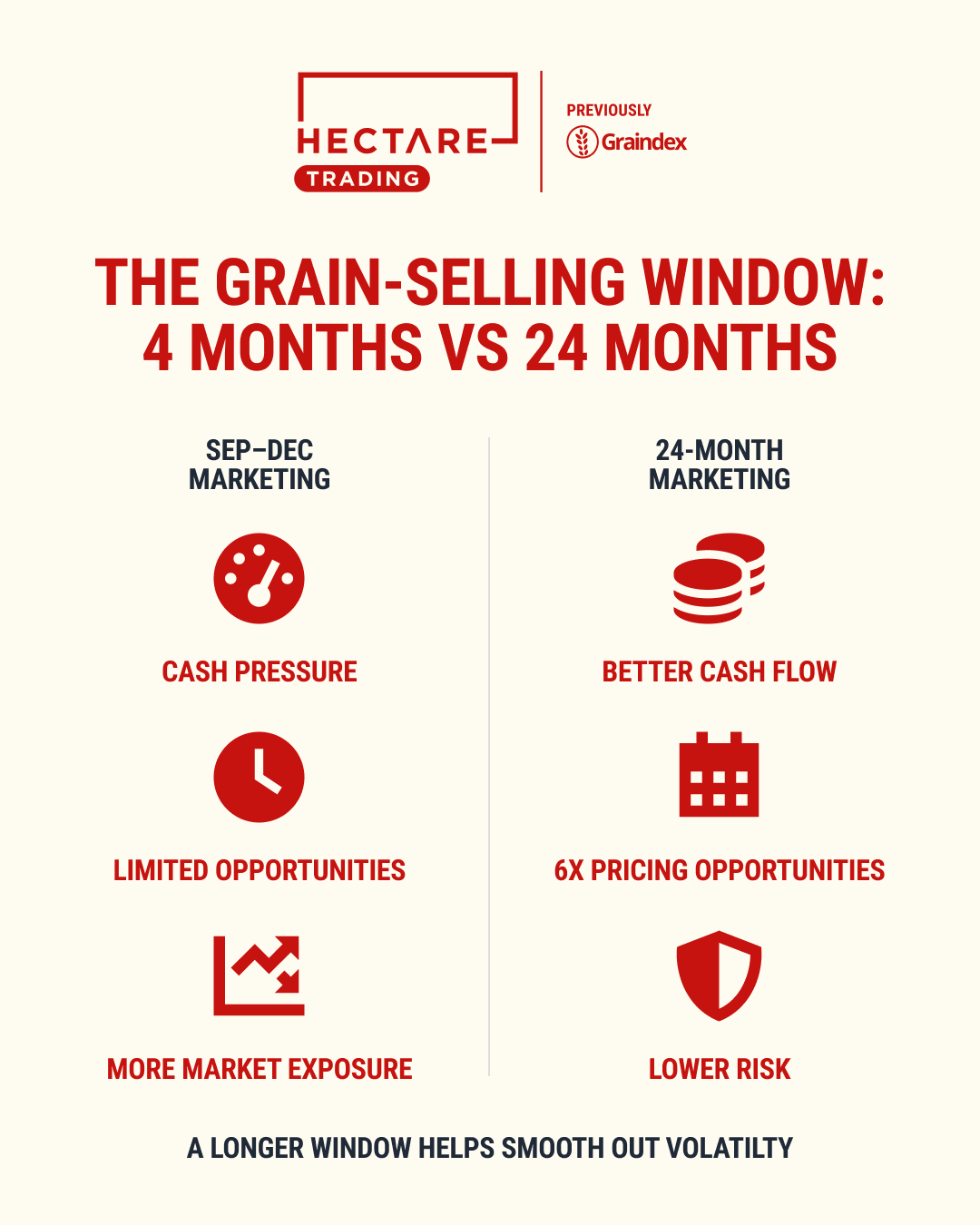
By selling up to 12 months before and after harvest, you can smooth out market volatility and take more control of your grain marketing
Pre-harvest trading: more time, focus on price
When you sell before harvest, you have time on your side: a much longer period in which you can catch favourable prices.
You can also take advantage of the carry on forward contracts, that is, the typical premium in the grain market for selling for future delivery.
As soon as you know what you’re growing, you can start selling. For any given harvest year, this could be up to 12 months or more before harvest.
Work out the minimum amount you need to move at harvest to keep the business running smoothly. If you know cash is required shortly after harvest, protect yourself by ensuring those tonnes are sold at acceptable levels well in advance.
As growing progresses, you’ll build your confidence on expected yields: if drilling went well, the winter hasn’t been too wet, the crop is looking strong into the crucial spring/summer period. You can now firm up the tonnage you’re expecting (while making some allowance for historical variability) and start selling that down.
You don’t have to trade if the price doesn’t stack up, but having the option to sell gives you flexibility and security.
Post-harvest trading: watch storage constraints
Once the crop is in the shed, the question becomes: is the market paying you enough to keep it there? You can sell for immediate movement or sell forward if the carry beats your costs, including both your direct storage costs and your opportunity costs.
A strategy of selling little and often can help you offload your crop without relying on one good price to secure your profitability. In some cases, farmers with sufficient storage could be selling their crop for movement up to 12 months after harvest.
Post-harvest selling for late movement (for example, May to July the year after harvest) can attract high prices, partly due to the carry but also because of the seasonal availability of grain in the northern hemisphere.
Of course, you always need to keep in mind the practical realities that constrain your timing: your cash-flow needs, your storage limits and the risk of crop deterioration.
If you have limited storage, you should keep in mind that grain stores tend to fill up towards the end of the year. By holding on to crop too long, you could lose the chance to sell or have to sell at a worse price just to offload.
Putting a 24-month strategy into action
Start marketing as soon as the crop is decided
Sell in manageable chunks to smooth out volatility
Lock in good prices with forward contracts when the market offers them
Keep a clear view of storage and other constraints to avoid forced sales
A wider selling window doesn’t add complexity – it adds control. With good planning, and the right marketing tools, this approach can strengthen margins, reduce your exposure to unlucky timing and make your grain marketing more robust over the long term.
Ready to sell now or looking to take the temperature of the regional market? Post a free crop listing on Hectare Trading today.
This article is for general information only and is not an instruction to trade. While we make every effort to ensure the accuracy of the content at the time of publication, Hectare Trading makes no guarantee regarding the data provided.