
How to assess a grain marketing strategy
3-MINUTE READ
How do you know if your grain marketing strategy is working for you? It’s tempting to look straight at the bottom line – but profit alone doesn’t tell the whole story.
It helps to separate strategy from tactics. Tactics are your day-to-day decisions while your strategy is your long-term plan. Ideally, your strategy is strong enough to guide your daily decisions, but flexible enough to give you tactical manoeuvrability.
Essentially, a strategy is a way of managing risk over time. When assessing success, you’re really judging how well your strategy supports consistent decision-making towards your business goals within your acceptable bounds of risk.
Managing market risk
If you divide your total sales revenue on a crop by the tonnage sold you can see your average selling price. (This is simple to track via the Crops dashboard on Hectare Trading.) Compare this with the average market price over the same period in your region.
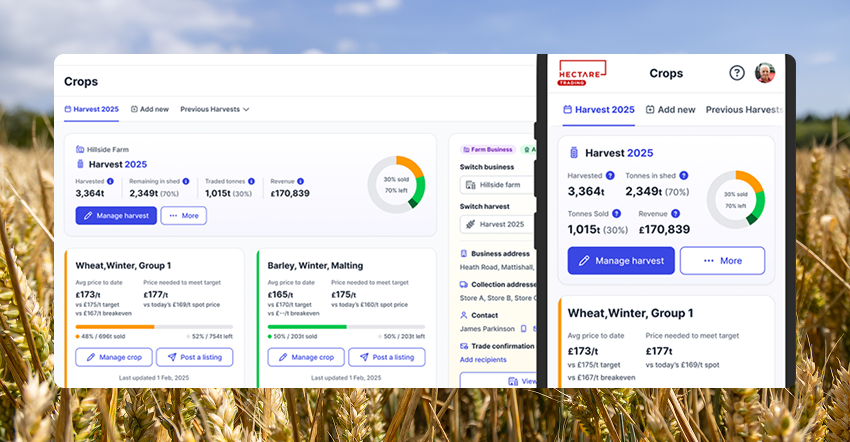
Track your grain marketing strategy using the Crops dashboard on Hectare Trading
Say you have sold your 2025 feed wheat little and often, in Lincolnshire, from January 2025 to May 2026. Your total revenue on 2025 feed wheat is £211,932 and you’ve sold 1,218 tonnes, so your average price is £174/t.
Our ex-farm spot price in the Midlands has fluctuated in this period from below £160/t to above £182/t, with an average market price of £170.30/t.
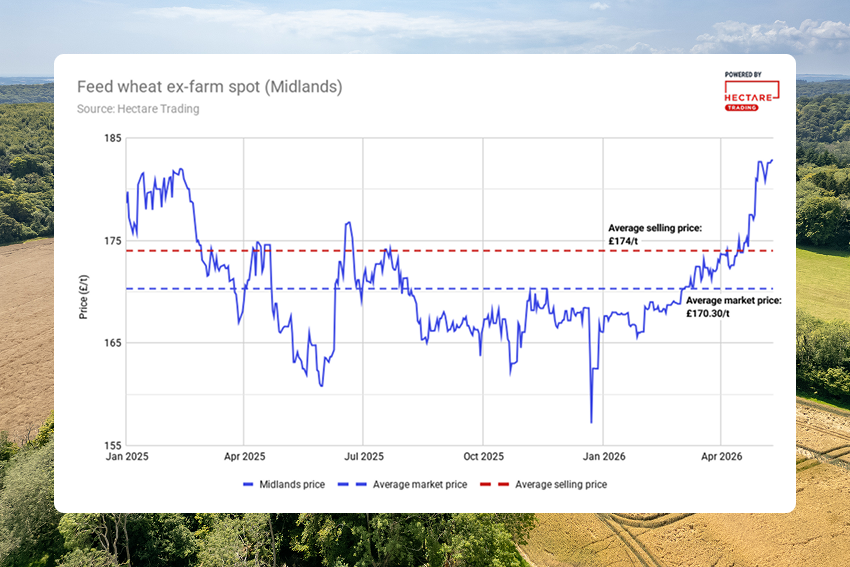
Start by comparing your average selling price with the average market price in your region
By selling little and often, you have reduced your exposure to market dips. Keeping some flexibility on tonnage has also allowed you to sell into market rallies – so your average selling price has stayed ahead of the market average.
If your performance relies on one or two perfectly timed trades, that’s not a robust strategy. You might get lucky, but your exposure to market risk is high.
Risk diversification
Strong grain marketing strategies spread risk rather than concentrating it.
That might mean selling throughout the year, using different contract types or working with multiple buyers. The aim is to reduce exposure to sudden market shocks or single points of failure.
Consider:
Have sales been spread across the season or bunched into one or two decisions?
Have I used different contract types where appropriate (for example, feed base or premium-only contracts on pre-harvest sales)?
Am I reliant on one buyer or have I diversified my outlets?
Over-concentration – whether in timing, pricing or buyers – creates vulnerability.
Managing logistical risk
Even the best market strategy fails if it doesn’t fit the practical realities of your farm.
Storage capacity, haulage availability and cash flow all shape marketing decisions. If logistical pressure forces you to sell at the wrong time, your strategy needs adjusting.
Ask:
Has my strategy supported my cash-flow requirements?
Have I used storage efficiently and economically?
Have logistical pressures ever forced me into unwanted sales?
A workable strategy should reduce stress – not create it.
Managing business risk
There’s no single perfect strategy – only one that fits your business.
Your approach should reflect your risk tolerance, borrowing needs and available management time. A highly complex strategy may look good on paper but fail in practice if it’s too demanding to manage.
Think:
Does this strategy match my appetite for risk?
Has it reduced reliance on short-term borrowing or overdrafts?
Does it fit realistically within my time and management capacity?
If a strategy doesn’t support the wider business, it won’t be sustainable.
The review cycle
A structured post-season strategy review is one of the most valuable habits you can build. It turns experience into progress.
Did you stick to your strategy through the year or did you find yourself deviating from it? Pick out what worked well and what didn’t. Were any of your decisions driven by emotion or pressure rather than planning?
Strategies only improve if they are reviewed systematically against these criteria – whether your overall bottom line is healthy or not.
If your strategy helps you to stay flexible, avoid forced decisions and spread risk across the season, it’s doing its job. Even if – or especially if – market conditions are poor.
A regular review cycle will help you develop a diversified grain marketing strategy that optimises your market performance, supports your logistical constraints and fits your farming business.
Use the Crops feature on Hectare Trading to plan and assess your marketing strategy. If you have 2025 crop to clear, or you want to lock in a price on some of your 2026 crop, post a listing today.
This article is for general information only and does not constitute advice. While we make every effort to ensure the accuracy of the content at the time of publication, Hectare Trading makes no guarantee regarding the data provided.