
What’s next for UK farming? Insights from Cereals 2026
3-MINUTE READ
Around 25,000 farmers, agronomists, merchants and industry professionals headed to Diddly Squat Farm last week for Cereals 2026, the UK’s largest arable farming event.
Across two packed days, visitors explored the latest crop varieties, machinery, agronomy trials and market insights, while also tackling some of the biggest questions facing UK agriculture.
Market outlook: uncertainty remains the only certainty
Robert Kaushish, Chief Economist at AHDB, provided an update on the UK and global grain markets and the outlook for harvest 2026.
He stressed the importance of using reliable data to guide grain marketing decisions for 2026 and planting choices for 2027.
AHDB’s Senior Analyst, Anthony Speight, highlighted how extreme weather events are heightening production risk around the world. Nonetheless, while UK crop conditions for 2026 have recently been revised downwards, they remain better than many growers have experienced in recent years.
For the 2026/27 season, AHDB expects:
Wheat carry-in stocks to be broadly in line with five-year averages
A mixed outlook for overall crop production
Low human and industrial demand for barley
Continued geopolitical uncertainty influencing UK farmgate prices
One interesting observation was the recent convergence of post-harvest London feed wheat and Paris milling wheat futures.
If we compare the London November 2026 and Paris December 2026 contracts, we can see that, from a deficit of nearly £10/t in mid-March, the London contract moved to £0.32/t higher than its Paris counterpart by 12 June.
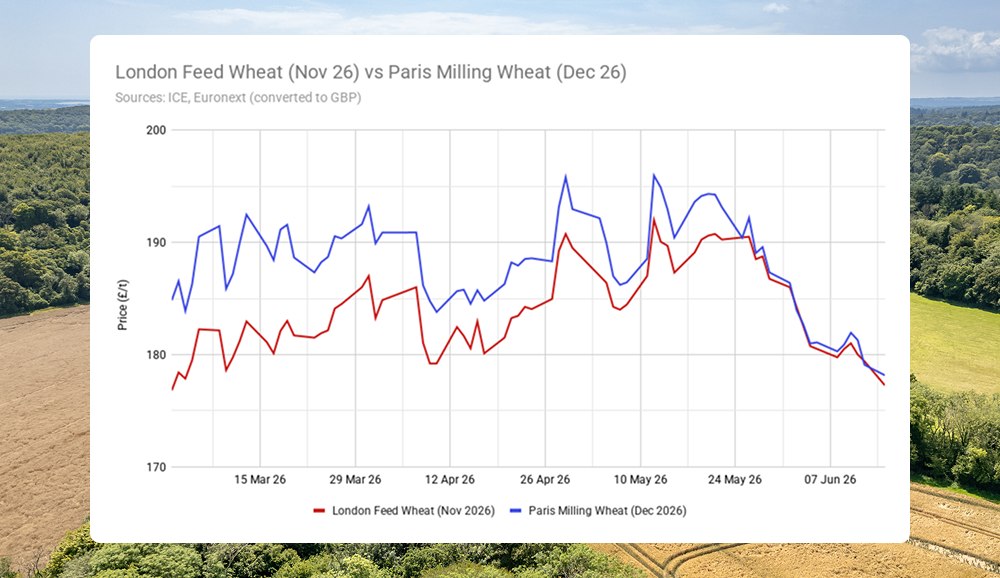
Post-harvest London and Paris wheat futures have converged in recent months
This move towards parity suggests the UK grain market could become increasingly reliant on imports, depending on domestic production and quality.
AHDB’s message to growers was clear: take advantage of pricing opportunities when they arise. Supply concerns take time to push markets higher, but prices can fall rapidly when production prospects improve, as recent changes to US weather conditions have demonstrated.
Agricultural policy: a growing concern
Away from the markets, agricultural policy was never far from the conversation.
Many farmers expressed frustration at what some described as a policy vacuum, with uncertainty over the long-term direction of UK agriculture continuing to weigh on business planning.
Jeremy Moody of the Central Association of Agricultural Valuers (CAAV) argued that the UK currently has more of a food policy than an agricultural policy. He suggested that recent government priorities have focused heavily on keeping food prices low during the cost-of-living crisis, often at the expense of farming profitability and domestic food security.
He called for a more comprehensive agricultural strategy that supports productivity, investment and resilience against both supply chain shocks and increasingly volatile weather.
The topic also surfaced during the Farmers Weekly podcast recorded at Cereals. Patrick Galbraith from the Daily Telegraph noted that opposition parties are similarly vague on their agricultural policy aims.
Along with Charlie Ireland and George Badger from Ceres Rural, he recognised that public sympathy for farmers has greatly increased in recent years, but the public still demands cheap food.
The question remains: will greater public understanding of the challenges facing farmers ultimately shift buying behaviour to support UK agriculture?
Looking beneath the surface
One of the most talked-about attractions at Cereals was Niab’s impressive 20-metre-long soil hole.
Excavated to a depth of 1.8 metres, the pit offered visitors a rare opportunity to see exactly how crops interact with the distinctive Cotswold brash soils found at Diddly Squat Farm.
The profile revealed shallow topsoil above subsoils containing around 40% limestone. Visitors could compare root development across a range of crops and management approaches, including low- and high-nitrogen winter wheat, winter barley and winter rye.
The display provided a powerful reminder that understanding soil structure remains fundamental to unlocking crop performance and resilience, particularly as weather patterns become more unpredictable.
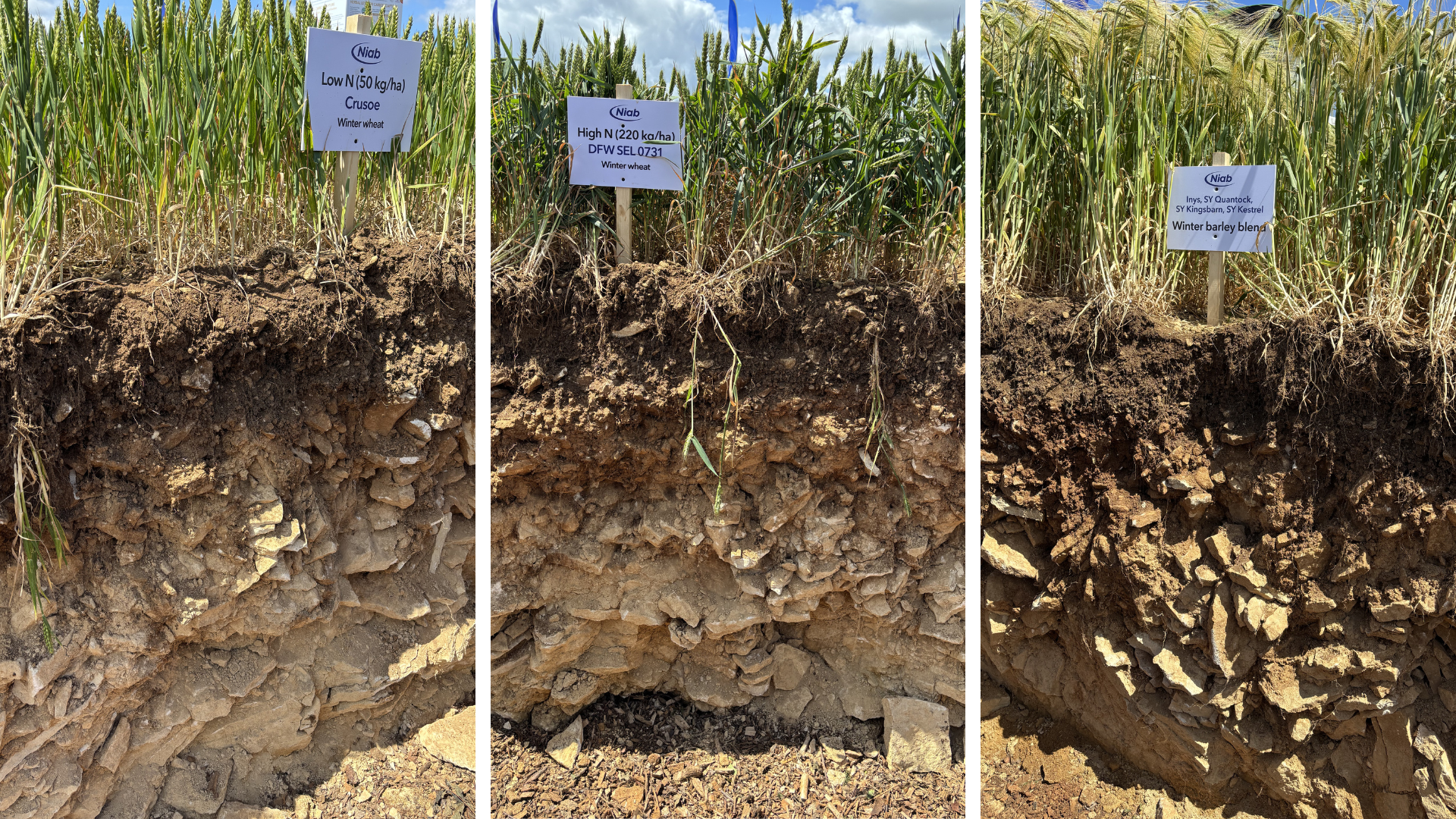
The Niab soil hole showed how crop roots interact with soil structure
The future of grain marketing
We were delighted to host our own panel discussion at Cereals examining the future of grain marketing.
The session featured James Peck of PX Farms, Ryan McCormack of Dennington Hall Farms and Andrew Huxham of Up Marden Farms, who shared practical insights from their own marketing approaches.
Despite their different farming businesses, all three panellists agreed on one central principle: successful grain marketing depends on reducing emotion and increasing discipline.
James Peck discussed the importance of setting target prices and sticking to them. Many growers establish a selling target, only to hesitate when the market reaches it, wondering whether prices might climb even higher.
His advice was simple: trust the strategy you established when emotions were removed from the equation.
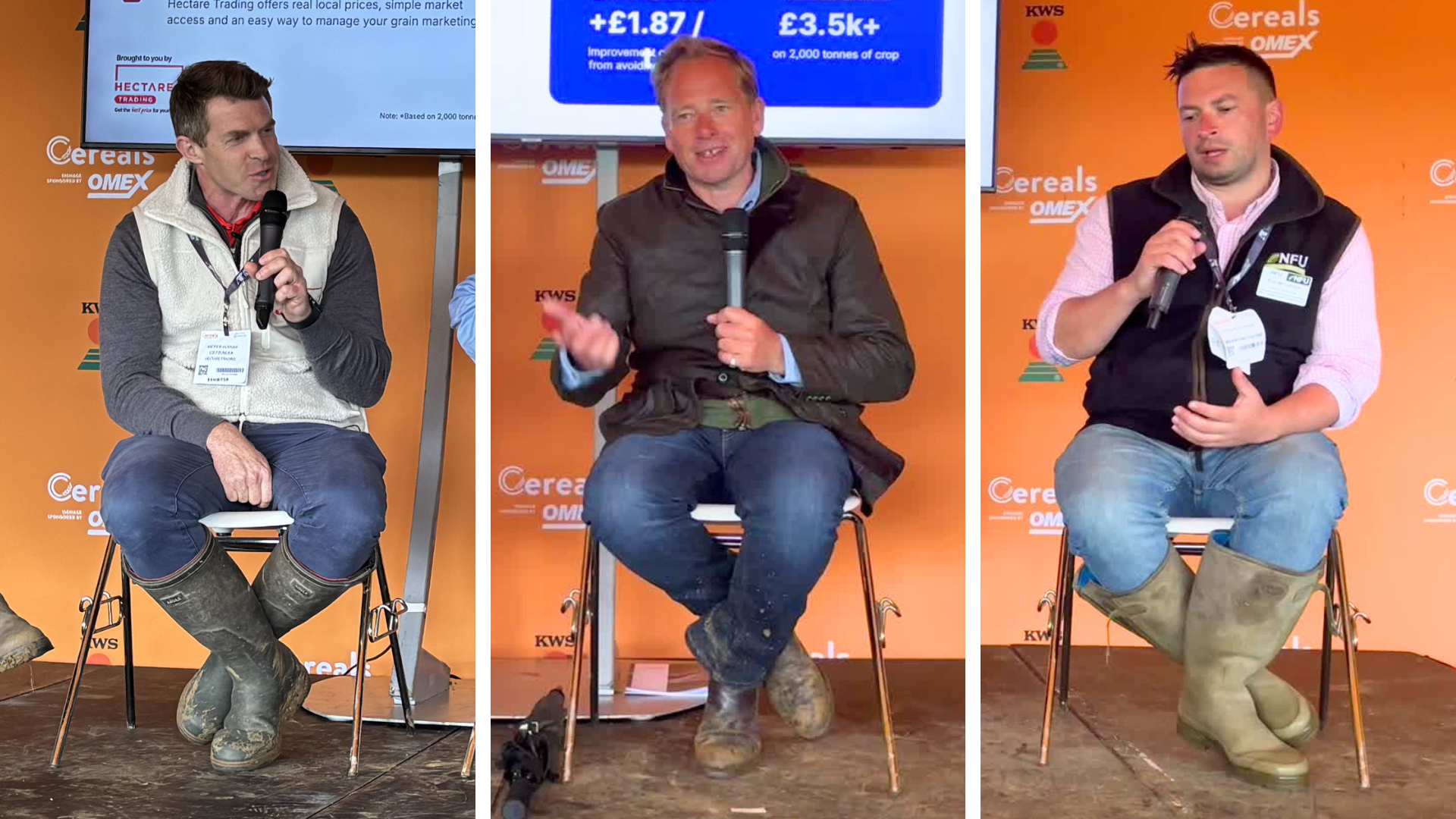
Right to left: Andrew Huxham, James Peck, Ryan McCormack
Andrew Huxham explained how he aims to sell at least a portion of one crop every month of the year. Importantly, he records the reasoning behind every sale, allowing him to review decisions later based on the information available at the time, rather than judging solely on the final outcome.
Ryan McCormack emphasised “decision over delay, and strategy over sentiment”. Once production figures are understood, he prefers to market grain actively and regularly – closely monitoring his average selling price across each crop.
The discussion reinforced the message that consistency and a clear strategy often matter more than attempting to predict every market movement.
Supply chain collaboration and business planning
One particularly insightful panel explored the malting barley supply chain, bringing together representatives from every stage of the journey, from breeding to brewing.
The discussion highlighted both the opportunities and challenges involved in meeting quality specifications across the supply chain.
Meanwhile, succession planning and estate management featured prominently throughout the event. Speakers repeatedly stressed the importance of involving all family members and business partners in long-term planning conversations.
As farm businesses become increasingly complex, clear communication and defined responsibilities are becoming just as important as agronomy and marketing decisions.
Key takeaways from Cereals 2026
If there was one theme that linked many of the discussions at Cereals 2026, it was uncertainty.
Whether discussing global grain markets, government policy, weather risk or future business planning, growers face no shortage of variables outside their control.
Yet the event also highlighted where farmers can make a difference. Better use of data, disciplined grain marketing, deeper understanding of soils and clearer long-term strategies all help improve resilience in an increasingly unpredictable environment.
As another harvest approaches, Cereals 2026 offered a timely reminder that, while nobody can control the market or the weather, having a robust plan remains one of the most valuable assets any farming business can possess.
Have you got grain to move before harvest? Homes are filling up fast and we’re currently seeing strong prices for old crop moving in July.
Post a listing today and see if you can clear your shed.
This article is for general information only and does not constitute advice. While we make every effort to ensure the accuracy of the content at the time of publication, Hectare Trading makes no guarantee regarding the data provided.