
Our benchmark spot prices (East Midlands)
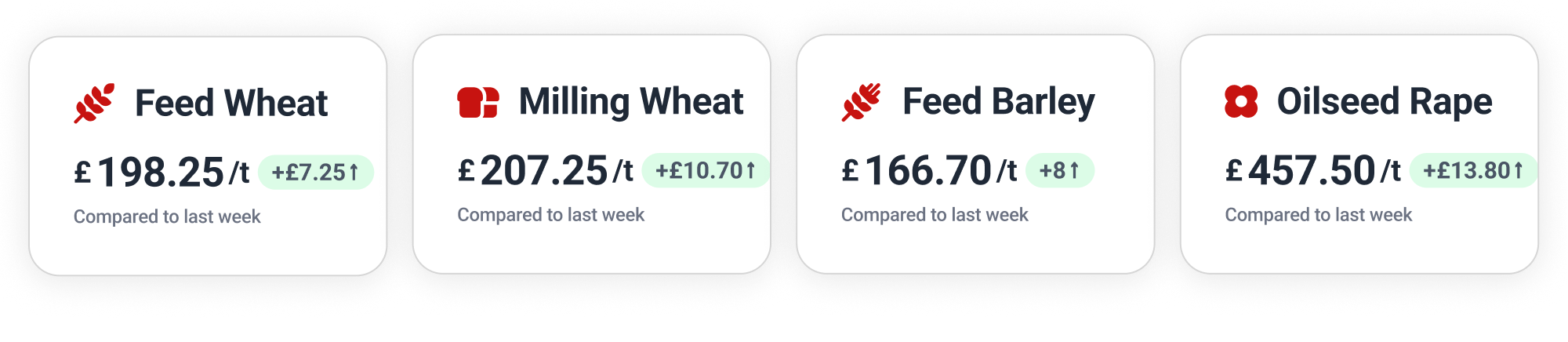
Feed Wheat
It has been a highly volatile week, with unprecedented surges in futures markets driven by a deep supply crisis, intensifying geopolitical risk, and widespread weather concerns.
The primary catalyst remains severe disruption in the Black Sea. Russia has warned it's unsafe to navigate its Black Sea exclusive economic zone following fresh Ukrainian strikes, prompting Ukrainian shipowners to suspend vessel arrivals and effectively shutting down a third of Ukraine's Black Sea export capacity. Moscow has offered to subsidise rail freight as an alternative route, but importers are already pivoting to Western Europe, with French loadings at Rouen doubling this week to over 200,000 tons.
On the futures front, the London November feed wheat contract has tracked the spot market volatility closely. Having closed last Friday at £196.25, it edged up to £198.50 by Monday's close and £199 on Tuesday, before rocketing £8 higher on Wednesday to £207 – a fresh high for the run. The contract eased back £1.50 on Thursday to close the week at £205.50, with the November 2027 contract at £200.50 — an inversion showing old crop trading above new crop, underlining the severity of the current squeeze.
On Hectare Trading, this volatility has driven active engagement, with farmers receiving bids up to £213/t for feed wheat.
For full spot and futures price analysis, visit our enhanced Insights on Hectare Trading.
Milling Wheat
Quality milling wheat also saw strong mid-week gains before a late correction. US futures led the way, with Chicago Soft Red Winter wheat hitting a two-year high and Kansas Hard Red Winter a three-year high on Thursday.
In Europe, Paris September milling wheat futures told a similar story. Having opened the week at €234.75 (£200.55) on Friday, the contract ticked up to €235.25 (£200.97) on Monday before slipping back slightly, then jumped €9.50 on Wednesday to a new high of €244.25 (£208.66). Prices eased back to €243 (£207.59) on Thursday, though support remains firm, especially as harvest results turn mixed — early milling quality has been encouraging, but disappointing yields are fuelling expectations of a tighter feed wheat balance sheet.
Feed Barley
The winter barley harvest in England is complete, and spring barley cutting is now underway, with early yield and quality reports highly variable. Dry weather has pushed the harvest one to two weeks ahead of normal, but a tough growing season is raising concern that high screenings and poor retentions could downgrade significant volumes of spring barley into the feed market.
On Hectare Trading, farmers received bids for feed barley up to £196/t for May 2027 movement.
Oilseeds
Oilseeds were the standout performer this week, though futures told a choppier story than the spot market. The Paris August rapeseed contract jumped to €557.25 (£476.06) on Monday, before giving back ground to €547 (£467.30) on Tuesday and €540.50 (£461.75) on Wednesday. It recovered €3.50 on Thursday to close the week back at €544 (£464.74) — a round trip that leaves the contract flat on the week but masks some sharp intraday swings.
This rally is being driven by several factors: Canadian canola futures hit fresh three-year highs, up nearly 4% on the week, as the Prairies swing from excess moisture to extreme heat of up to 35°C, threatening yields. On top of this, energy markets have added fuel — Brent crude broke through $100 a barrel for the first time in two months after Houthi forces claimed drone strikes on two Saudi tankers in the Red Sea, sparking speculative buying across the vegetable oil sector.
While a large exportable surplus is expected to move from Ukraine into the EU and UK, Black Sea logistical bottlenecks mean rapeseed remains highly sensitive to geopolitical headlines.
On Hectare Trading, oilseed rape saw bids of up to £471/t for November 2026 movement.
Wanted Crop
🌾 Feed wheat is wanted for collection in the East Midlands, for movement in August. Guide price of £186–190/t ex-farm.
🌾 Feed barley is wanted for collection in Yorkshire and the Humber and the East Midlands, for movement between September and December. Guide price of £175–182/t ex-farm.
🌾 Group 1 wheat is wanted for collection in East Anglia, Essex, Hertfordshire and the East Midlands, for movement between August and September. Guide price of £185/t ex-farm.
🌾 Feed barley is wanted for collection in East Anglia, Essex, Hertfordshire and the East Midlands, for August movement. Guide price of £165/t ex-farm.
🌾 Feed barley is wanted for collection in Yorkshire and the Humber, for August movement. Guide price of £175–180/t ex-farm.
🌾 Feed wheat is wanted for collection in the North West, West Midlands and North Wales, for movement between September and November. Guide price of £200.00–203.00/t ex-farm.
🌾 Group 1 wheat is wanted for collection in Yorkshire and the Humber, East and West Midlands, for August movement. Guide price of £210–220/t ex-farm.
🌾 Group 1, 2 or 4 hard wheat is wanted for collection in East Anglia, East Midlands, Essex, Hertfordshire, Oxfordshire & Buckinghamshire, for August movement. Guide price of £190–195/t ex-farm.
This article is for general information only and does not constitute advice. While we make every effort to ensure the accuracy of the content at the time of publication, Hectare Trading makes no guarantee regarding the data provided.