
Black Sea logistics crisis keeps grain markets on edge
Our benchmark spot prices (East Midlands)
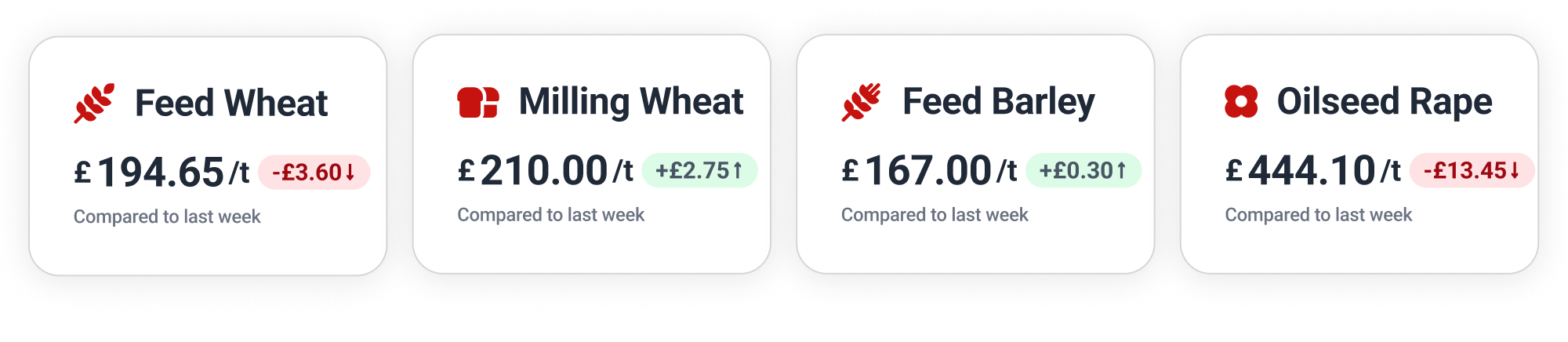
Feed Wheat
The wheat market is still beset by the escalation of Black Sea logistics risks, with Ukraine reporting to the UN that the current situation threatens global food security. Trade flows remain disrupted, prompting Egypt to halt its wheat-buying programme.
Meanwhile, production forecasts in the Northern Hemisphere are suffering from the severe weather. The EU’s MARS monitoring service this week reduced its harvest forecasts for all crops in the EU for 2026 due to the prolonged hot, dry conditions and warned of further downgrades.
By contrast, the Southern Hemisphere is providing a crucial buffer with significant production upgrades. The USDA has raised Australia’s 2026/27 wheat forecast by 2 million tonnes to 31 million tonnes, and boosted Argentina’s wheat forecast to 21.6 million tonnes.
After pulling back below £200 last Friday, the November 2026 London feed wheat contract eased slightly to £199.50 on Monday, and by Wednesday’s close was £1 further back at £198.50. In intraday trading on Thursday, the contract jumped back above £200, hitting a high of £204.50 before closing at £199.75.
For full spot and futures price analysis, visit our enhanced Insights on Hectare Trading.
Milling Wheat
With UK wheat yields generally low so far, feed wheat supply is expected to be relatively tight. This is keeping feed wheat prices strong while narrowing domestic milling premiums.
Further afield, Algeria – traditionally one of the world’s largest grain buyers – has announced it will be completely self-sufficient in durum wheat this year, with a stellar domestic harvest saving the country an estimated $1.5 billion in imports.
Meanwhile, the Turkish Grain Board has officially authorised the export of milling wheat, lifting a ban that had been in place since March 2025. Although exports remain subject to strict government oversight, the move could significantly shift Black Sea supply dynamics.
Having climbed over €42 since the start of July, the September 2026 Paris milling wheat contract gave up ground early in the week, dropping to €229.25 (£196.06) on Monday and €226.50 (£193.96) by Wednesday’s end. A healthy rebound on Thursday saw the contract close the day at €229.50 (£196.46).
Feed Barley
Grain trade association Coceral has cut its barley production forecast for Europe and the UK to 57.6 million tonnes – an 8% drop on last year’s 63.8 million tonnes. Meanwhile, quality downgrades in the winter crop are pushing malting barley into feed channels.
In contrast, Ukraine is harvesting a massive barley crop, with average yields a third higher than last season at 4.41 to 4.42 t/ha (compared to 3.33 t/ha in 2025). However, due to the deep-water seaport blockades, farmers are unable to easily monetise these strong yields.
Oilseeds
US soybean crop ratings deteriorated from 66% to 63% good-to-excellent as dry, hot weather hit the Corn Belt. Total US soybean export commitments are down 18.5% year-on-year as Chinese purchases plunged 45% to 12.4 million tonnes due to trade friction and a 10% import tariff.
In Europe, the MARS report reduced the EU rapeseed yield forecast by 2% to 3.14 t/ha due to the June and July heatwaves accelerating crop ripening, although, according to Coceral, the total European and UK rapeseed crop will remain relatively resilient at 21.2 million tonnes (against last year’s 21.4 million tonnes).
Paris rapeseed futures started the week in the red, the November 2026 contract falling over €14 to €536.50 (£458.84) on Monday. A lack of momentum saw the contract drift further down to €531.00 (£454.27) on Tuesday, pick up slightly to €531.25 (£454.94) on Wednesday, then close Thursday at €527.75 (£451.77).
Wanted Crop
Got crop that hasn’t met spec?
We have a buyer in Cambridgeshire looking for 10,000 tonnes of low-spec Group 1 or Group 2 wheat or any grain that is too dry. He also wants to move 4,000 tonnes of feed barley as soon as possible.
🌾 Feed barley is wanted for collection in the South West, for movement between January and June 2027. Guide price of £185– 190/t ex-farm.
🌾 Linseed required for collection in the South, South East and South West, Oxfordshire, Buckinghamshire, Essex, Hertfordshire, the East and West Midlands, East Anglia and Yorkshire and the Humber. Movement between August and October, with a guide price of £590/t ex-farm.
🌾 Feed wheat is wanted for collection in East Anglia, for August movement. Guide price of £185–188/t ex-farm.
This article is for general information only and does not constitute advice. While we make every effort to ensure the accuracy of the content at the time of publication, Hectare Trading makes no guarantee regarding the data provided.