
Rising input costs keep UK wheat margins under pressure
Our benchmark spot prices (East Midlands)
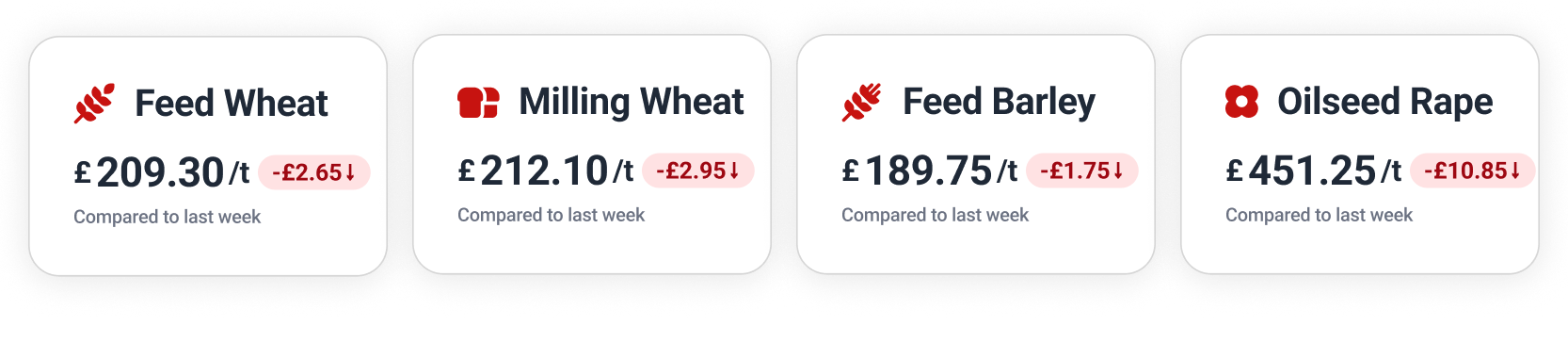
Feed Wheat
UK wheat production costs are creeping upwards, as surging diesel prices and firm domestic nitrogen fertiliser values are keeping profit margins tight for the 2026/27 crop year.
Last week’s WASDE report surprisingly raised its forecast for 2026/27 global wheat ending stocks by 3.04 million tonnes to 276.29 million tonnes, while global wheat trade was cut by 0.9 million tonnes due to Black Sea shipping bottlenecks.
The Kremlin held emergency meetings this week urging exporters to defend its position in the global wheat market as US wheat exports surpassed Russia’s global market share (now at 19.8% compared to Russia’s 18.1%).
London feed wheat futures have lacked direction this week. The November 2026 contract slipped to £208.00 on Monday before recovering to £210.25 at Wednesday’s close. Trading in a narrow band on Thursday, the contract finished at £210.00.
For full spot and futures market analysis, check our Insights on Hectare Trading.
Milling Wheat
Over 50% of the 2026 French wheat crop met milling specifications (against a five-year average of 15%), providing high-quality, competitive supply across Western Europe.
With Black Sea exports having halved year-on-year, Expana raised its EU soft wheat export forecast to 29.5 million tonnes as international buyers shift demand toward European milling wheat.
In the UK, with milling wheat failing to deliver expected financial returns in many regions, growers preparing for autumn drilling are increasingly looking toward higher-yielding group 4 hard varieties to maximise tonnage per hectare.
The December 2026 Paris milling wheat contract held above €240 this week, dropping to €240.50 (£205.86) on Monday but bouncing back to €244.50 (£209.63) at Wednesday’s close. A lack of momentum saw the contract finish Thursday at €243.50 (£209.33).
Feed Barley
While the WASDE report raised Australia’s 2026/27 barley production forecast to a record 17.1 million tonnes following favourable winter rainfall, Australian barley values have dropped to their lowest level since January 2022 due to heavy supply and sluggish late-season demand.
EU barley exports from July to mid-September fell 39.9% year-on-year to 1.7 million tonnes, due to a 90% drop in Chinese purchases. Meanwhile, dry soil conditions in France are preventing rapeseed planting, prompting French farmers to plan an expansion of the 2027 winter barley crop to a 10-year high of around 1.4 million hectares.
Oilseeds
Heavy rainfall across western Canada has severely delayed harvest progress, creating near-term supply tightness. However, returning warm and dry weather across the Prairies is expected to accelerate harvest progress over the next fortnight.
According to the WASDE report, global oilseed production will hit a record 723.46 million tonnes in 2026/27, 22.42 million tonnes higher than the current estimate for 2025/26. This increase is largely driven by expanded rapeseed production.
Paris rapeseed futures started the week with moderate gains, the November 2026 contract reaching €554.25 (£474.33) at Tuesday’s close. The contract then lost ground, easing back to €550.75 (£472.21) on Wednesday, before finishing Thursday at €548.50 (£471.54).
Wanted Crop
🌾 Group 2 wheat is wanted for collection in the South West and West Midlands, for movement between October and December 2026. Guide price of £215–218/t ex-farm.
🌾 Feed oats required for collection in the East Midlands and Yorkshire and the Humber. Movement this month, with a guide price of £150–160/t ex-farm.
This article is for general information only and does not constitute advice. While we make every effort to ensure the accuracy of the content at the time of publication, Hectare Trading makes no guarantee regarding the data provided.