
Wheat prices firm as global supply concerns build
Our benchmark spot prices (East Midlands)
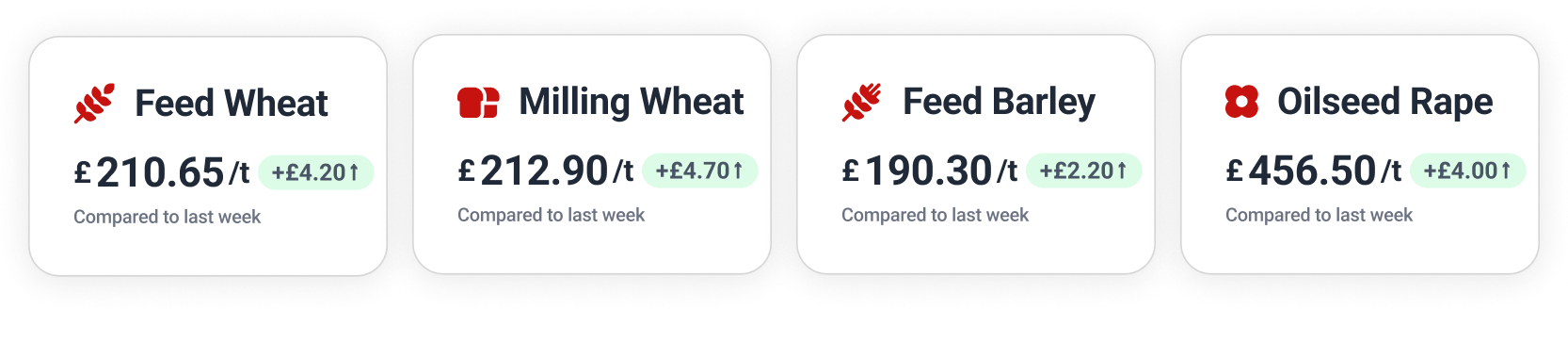
Feed Wheat
Representatives of 54 UN member nations called on UN agencies to help restore freedom of navigation in the Black Sea to safeguard global food security, after attacks on commercial vessels and strikes on port and transport infrastructure in Odesa and Kyiv.
S&P Global noted that Black Sea disruptions have added $45–$63/tonne in landed costs for major wheat buyers, including Saudi Arabia, Jordan, Algeria and Tunisia.
Meanwhile, US winter wheat planting has reached 36% completion, trailing 10 percentage points behind the five-year average. Supply concerns have been prompted by notable delays in Kansas, Oklahoma and Texas.
London feed wheat futures have started the month on the front foot, the November 2026 contract climbing £5.50 from the end of September to Tuesday’s close at £209.50. The contract gave back £1 on Wednesday, then finished Thursday further back at £206.50.
For full spot and futures market analysis, check our Insights on Hectare Trading.
Milling Wheat
Demand from UK flour millers increased by 0.8% year-on-year in August, at 422,900 tonnes. While cumulative milling for July–August was lower year-on-year due to reduced imported wheat usage, the inclusion of home-grown wheat increased.
High nitrogen fertiliser prices combined with modest milling premiums in recent seasons have encouraged some growers globally to reduce nitrogen applications, raising concerns over crop quality and protein levels in upcoming harvests.
Paris milling wheat futures have gained support from North African and Middle Eastern buyers seeking alternative origins to Black Sea supply.
After closing last week on an up-trend at €241.50 (£205.35), the December 2026 contract started with two days of gains to finish Tuesday at €247.50 (£210.08). Easing back to €244.25 (£206.75) on Wednesday, the contract then ended Thursday unchanged.
Feed Barley
The USDA reported that US barley production fell 19% year-on-year in 2026 to 116 million bushels (around 2.5 million tonnes) due to reduced acreage and lower yields, the steepest drop among US small grains this year.
Low pass rates for English spring barley (around 20% against a five-year average of 70%) are diverting more malting barley to feed channels. Stronger comparative margins for winter wheat and rapeseed are expected to result in a reduced spring barley area for the 2027 harvest.
Oilseeds
US biofuel producers consumed a record 1.69 billion pounds of soybean oil in July, up 52% year-on-year, due to soaring demand from the renewable diesel sector. Meanwhile, Brazil has expanded its annual soybean crushing capacity by 13% year-on-year to 86.4 million tonnes, driven by rising domestic biodiesel blending requirements.
In the UK, widespread failure of winter oilseed rape due to cabbage stem flea beetle and larval damage is prompting many growers to dig up failed OSR fields and plant winter wheat instead.
Paris rapeseed futures dropped sharply this week, the November 2026 contract sinking €31.25 over Tuesday and Wednesday to close at €506.25 (£428.52). Longer-term contracts began to recover on Thursday morning, while the November contract followed suit later to finish at €512.25 (£434.17).
Wanted Crop
🌾 Group 1 wheat (13/76/250) is wanted for collection in Yorkshire and the Humber, moving in January 2027. Guide price of £216–220/t ex-farm.
🌾 Feed wheat required for collection from Yorkshire and the Humber. Movement this month, with a guide price of £208–210/t ex-farm.
🌾 Group 1, 2 or 4 hard wheat wanted for collection in the East Midlands and Yorkshire and the Humber, moving this month. Guide price of £210–215/t ex-farm.
This article is for general information only and does not constitute advice. While we make every effort to ensure the accuracy of the content at the time of publication, Hectare Trading makes no guarantee regarding the data provided.