
3-MINUTE READ
With abundant supply depressing grain prices, what is the value of clearing out the shed now versus carrying old crop over to the new marketing year? And if you’re planning to hold grain over, does it make sense to lock in a price by forward-selling now?
As with most aspects of grain marketing, the right answer depends on your numbers, your storage position and your appetite for risk.
Global supply round-up
Latest USDA figures project global wheat production for 2025/26 at 844.2 million tonnes, 8.4% higher than the 10-year average of 778.6 million tonnes.
Other crops tell a similar story:
Barley: 154.9 million tonnes – up 4.2% against a 10-year average of 148.7 million tonnes
Oats: 25.6 million tonnes – up 8.9% against 23.5 million tonnes
Oilseed rape: 95.5 million tonnes – up 18.8% against 80.4 million tonnes
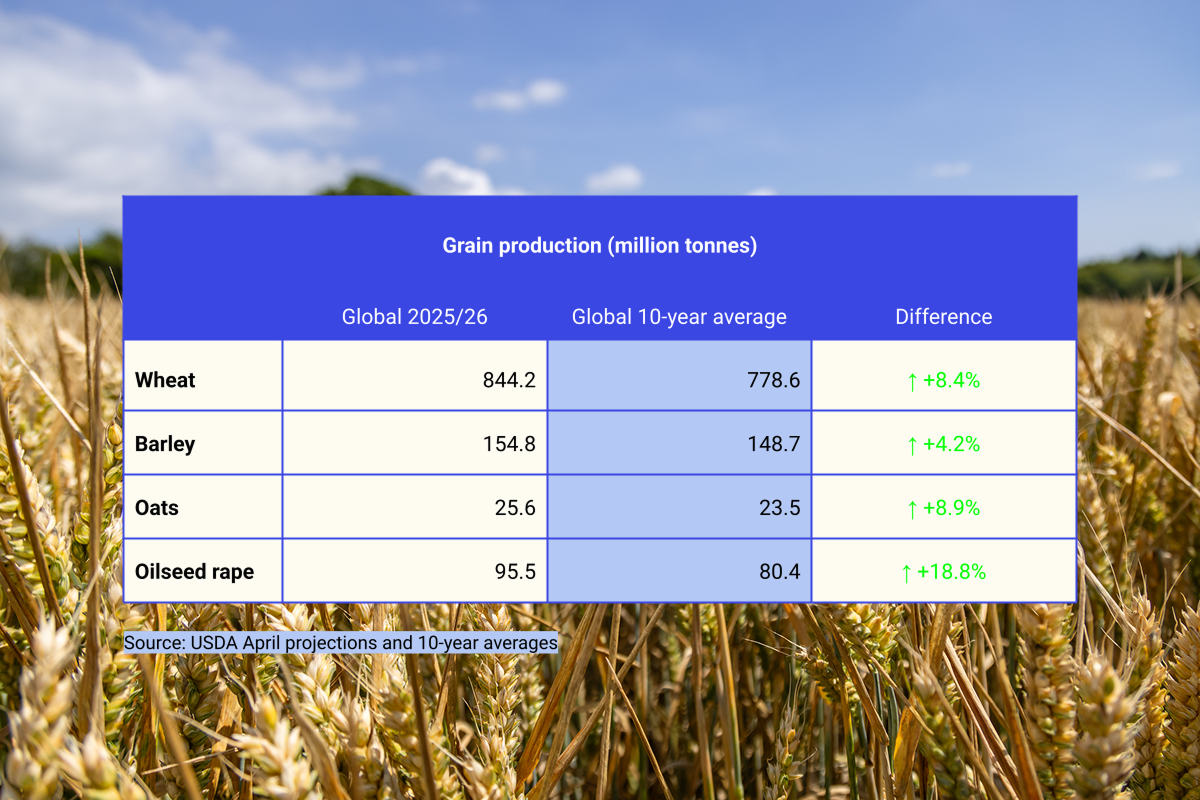
Global grain production: 2025/26 against 10-year averages
US production has stayed relatively stable over this period. High global production has instead been driven by major increases over 10-year averages in the EU, China and India, with increased planting and improved agronomy.
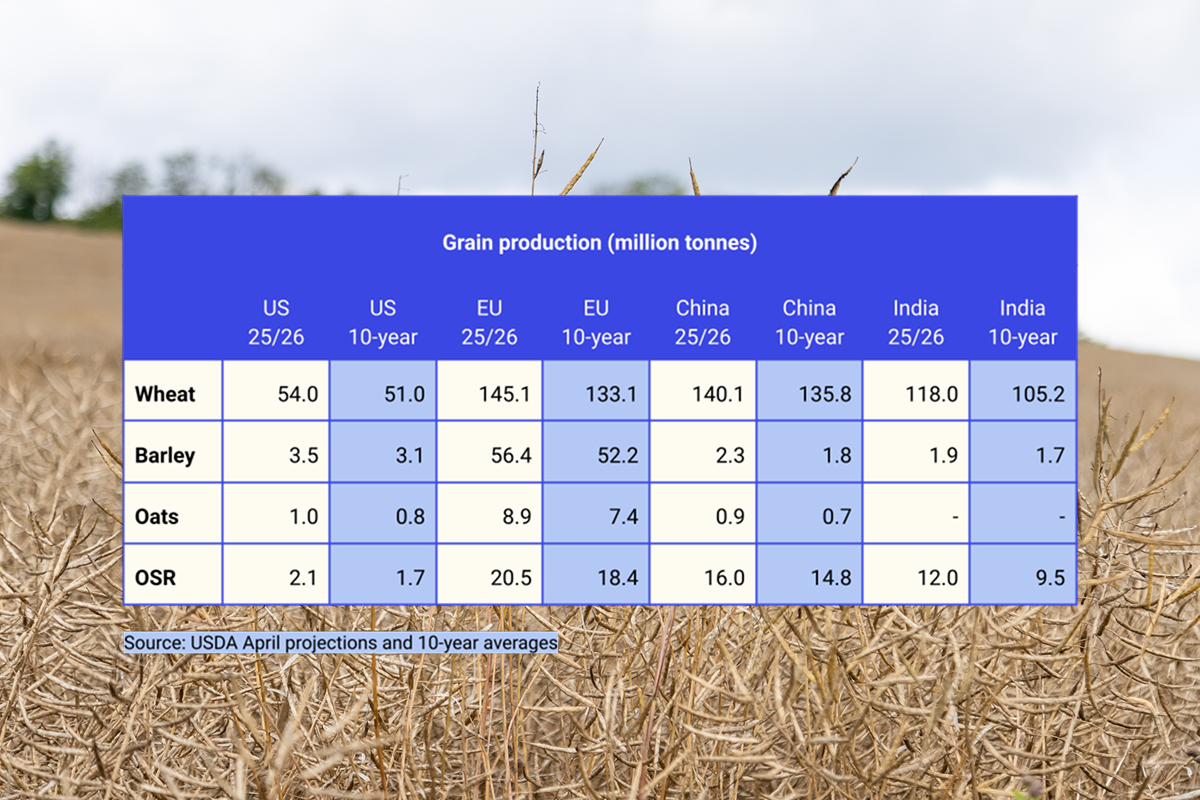
US, EU, China and India grain production: 2025/26 against 10-year averages
The picture is a little different in the UK due to recent poor harvests, causing more disparity between longer-term and year-on-year supply comparisons.
For example, domestic wheat production is projected at 12.0 million tonnes, against a 10-year average of 13.5 million tonnes. However, that’s still a rise of 7.1% over 2024/25’s 11.2 million tonnes.
Similarly, while OSR is well down on the 10-year average at 900,000 tonnes, this is a 9.8% improvement on 2024/25’s 820,000 tonnes.
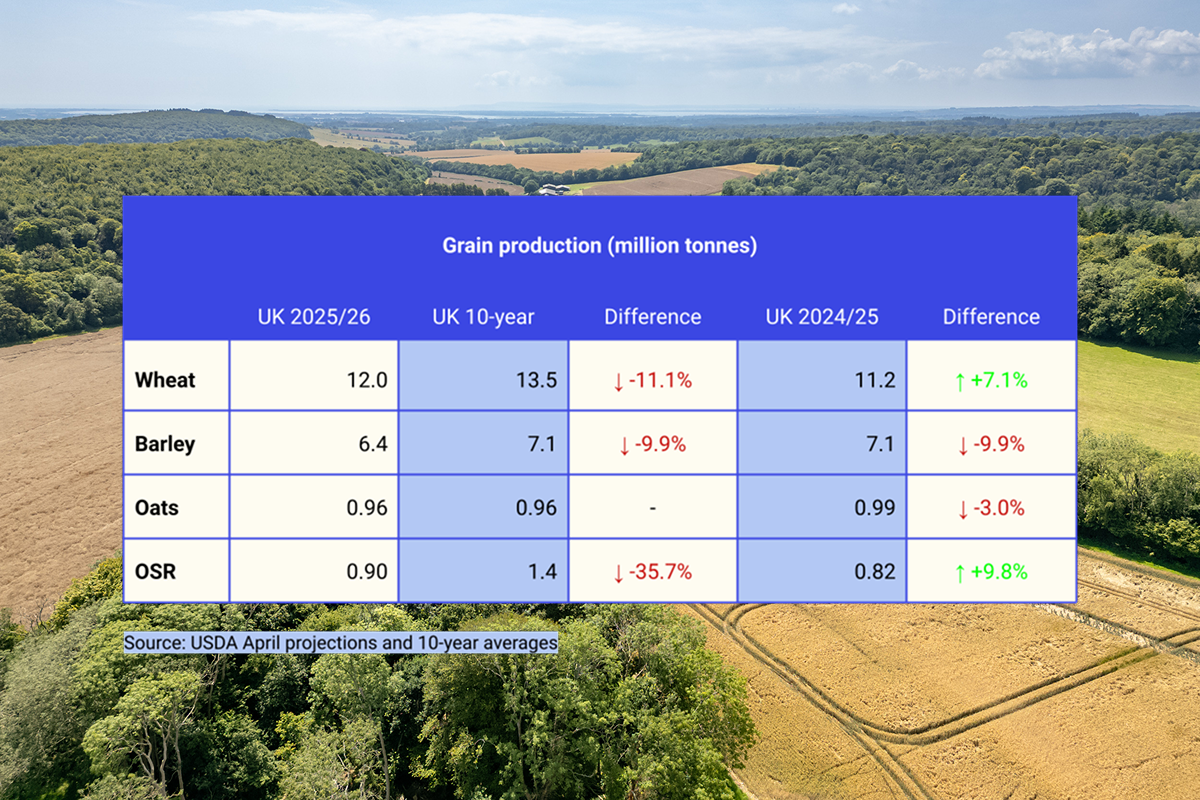
UK grain production: 2025/26 against 10-year averages and 2024/25
Plentiful supply weighs heavily on prices unless demand rises to match, but instead we’re seeing a growing surplus.
In fact, the USDA is projecting the highest global wheat ending stocks since 2019/20 at 316.2 million tonnes, 10% higher than last year.
Costs of holding over old crop
Some farmers have decided to hold their old crop over rather than sell at depressed prices. But does this make financial sense and what points do you need to keep in mind?
The most obvious is storage. Even if you have on-farm storage available, you should take into account your direct storage costs and opportunity costs for holding old crop.
For example, if selling grain now would allow you to reduce borrowing, how much interest could you save? That saving should be factored into the selling decision. Sometimes the true cost of holding grain is higher than it first appears.
These costs can be at least partially offset if you take a price on some of your stored crop now by forward-selling for movement later in the year.
Don’t wait too long
The major risk with a “wait and see” approach is that you might find it hard to move your crop later.
In oversupplied markets, downward pressure can persist longer than expected. Prices fail to recover and you’re forced to sell later at a lower price.
This problem is compounded if you need on-farm storage free for harvest. Leaving sales until late spring can leave you with limited options. By May or June, logistics tighten and movement windows shrink.
If your shed needs to be empty by July, waiting too long may force your hand.
Hold with a plan
Holding old crop over should be a purposeful strategy – not just to delay making a decision.
This can mean locking in a price on some of your old crop now by forward-selling, to take advantage of any carry in the market.
Look for where prices for post-harvest movement may bear a significant premium over spot prices. Does the carry exceed your extra storage costs?
Knowing you have a guaranteed price on a portion of your old crop can relieve stress, while you still retain some unpriced grain for potential market improvement.
If you’re holding old crop, be clear about:
Your breakeven and target prices
Your storage costs and deadlines
Your risk tolerance
Your cashflow requirements
Without those, decisions tend to be reactive – and reactive selling rarely delivers the best returns.
Strive for balance
If you’re holding grain, do it with a plan. If you’re selling grain, do it for a reason.
For many farming businesses, the most sensible approach isn’t all-in or all-out – it’s balance. Keep control by selling forward – stay flexible by holding back some crop unpriced.
This spreads risk across time rather than concentrating it in one decision. In uncertain markets, spreading risk is often the most valuable strategy of all.
Our market insights now include analysis of forward carry, along with recent prices for forward movement – broken down by crop and region.
Post a listing for post-harvest movement to see how much you could get for holding your old crop.
This article is for general information only and does not constitute advice. While we make every effort to ensure the accuracy of the content at the time of publication, Hectare Trading makes no guarantee regarding the data provided.