
June on the farm
Andrew Huxham is joined by independent agronomist Jonny James from Chichester Crop Consultancy, to discuss the use of crop trials, current crop conditions on Andrew’s farm in West Sussex and the prospects for harvest 2026:
Why June crop trials are invaluable – how independent agronomy and real-world variety trials shape harvest and drilling decisions
Getting oilseed rape desiccation right – why timing is everything when it comes to protecting yield, quality and harvestability
How is the heatwave affecting crops? – Jonny explains which crops are coping and struggling and what it could mean for yields
Harvest 2026 outlook – are winter crops still on track for a strong harvest despite the extreme weather?
Subscribe on YouTube
Make sure to subscribe to the Hectare Trading YouTube channel to follow all our videos through harvest 2026:
More monthly updates from Andrew Huxham
“Ask An Expert” – send us your own questions on arable farming
Our weekly grain market and harvest reports
Have you got grain to sell?
Whether you’re clearing old crop or locking in a price on new crop, post a free listing on Hectare Trading and see what buyers are prepared to pay for your grain.
Transcript
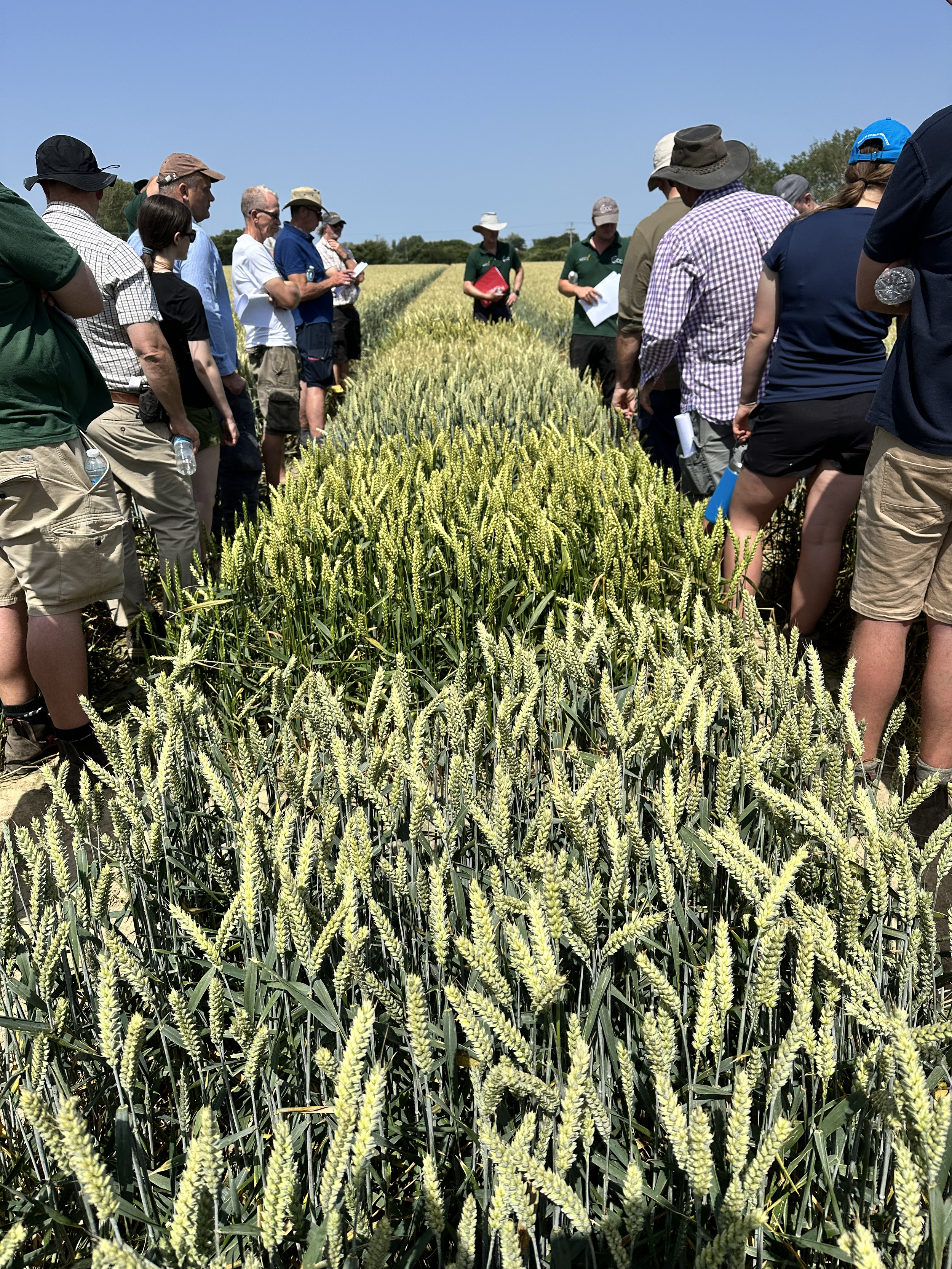
In June, Andrew Huxham visited crop trials at Hale Farm in West Wittering
Andrew
Hello and welcome to our “June on the farm” update. Today I’ve got with me Jonny James from CCC, Chichester Crop Consultancy.
June on the farm for us is really about a lot of harvest prep but the reason I’ve got Jonny with me is because across the UK there will be lots and lots of crop trials going on and across the UK there will be lots and lots of crop trials going on and earlier this week we went to some crop trials down at Hale Farm at West Wittering.
Can you just give us a little bit of, first of all, Jonny, actually tell us a little bit about CCC. Who is CCC and what do they do?
Jonny
So we’re an independent agronomy group set up in the 80s. We’re actually a bit unique in that we’re a cooperative as well as an independent company so we’re essentially owned by the farmer for the farmer. Every member has a direct share and interest in the group. We were set up in the 80s and we now cover between Dorset and Kent across the south of England. There’s five of us.
Andrew
Five full-time agronomists. And when you say independent, people often don’t believe this, but do you get any sort of kickbacks? Are you swayed by any particular manufacturers or anything?
Jonny
We have no commercial interest whatsoever at all. We’re purely paid on an acreage basis for advice – so that might be to do nothing – but we have no incentive to push product or sell product. We have no commercial interest, hence why we are members of the AICC, which is the biggest independent organisation across Europe.
Andrew
And the crop trials: why are people putting on all these crop trials and why do farmers go to them at this time of the year, because it’s quite a big thing in June, isnʼt it?
Jonny
It’s a really big thing and, for us, we’ve got a really good site down at West Wittering, so very local to where we are right now. It’s a great opportunity for us to come see new varieties, what disease pressures they’re under, and actually see them in an untreated situation as well as a treated situation. Obviously we’ve seen a big shift recently to the Yr15 genetics, yellow rust, so it actually gives us the first-hand opportunity to see what that looks like in the field in an untreated scenario. There was a hell of a lot of yellow rust and brown rust in the site down at Wittering and actually it’s really useful I think for farmers to come and see that first-hand and, you know, it’s not just us saying don’t grow this variety because of X, Y or Z. You can actually see it first-hand.
Andrew
I think for us, or me as a fairly risk-averse farmer, more often than not, what it does is confirm to me that I’m going to carry on doing what I did last year. We grow nearly all group 1 milling wheat and we’ve got quite a few new varieties come out now. We’ve moved over, so Skyfall, Zyatt and Vibe are what we’re growing this year, and I think, having been around the trials and looked and listened to you all this year, I think we’ll do the same next year. So even if it just confirms that that’s still the right thing to do, obviously we want to see how this harvest is going to progress.
So you’ll probably notice we’re stood in a field of oilseed rape, because the big question now is oilseed rape desiccation. So we’ll go through this with a dose of glyphosate and Pod-Stik, try and protect against crop losses when we’re combining, or adverse weather conditions for the Pod-Stik. And it’s all about timing, isn’t it, because if we go in too early the consequences are pretty severe.
Jonny
You’ll end up with a lot of red seed, poor oil content and it will have a knock on yield. So getting that timing right is quite key really.
Andrew
But the reason we’re doing it is really about the harvestability, isnʼt it? We had a bit of an issue last year where we probably tried to cut oilseed rape too early and the combine was broken down for several days with broken shafts and blockages and all sorts, so we do not want a repeat of that.
Right Jonny, show us what happens when you open up a pod. What are we looking for?
Jonny
So you’ve got that pod there, lots of them, see, green seeds have already turned brown. There’s a few just red ones there but they are turning naturally. Keep going through the pods.
Andrew
And these pods are fairly low down on the plant, aren’t they?
Jonny
Yes, so you want to pick 20 or so at random and just work your way across.
Andrew
And we’re looking for what colour?
Jonny
We want them to be brown or dark colour, black.
Andrew
And actually, if you look at some of these, you can almost shake the crop and hear them rattling in some of the top pods, because some of the top pods are almost to the point of being a little bit brittle where they’re almost ripe.
Jonny
A little bit of verticillium showing here on this. This is a crop of Matrix, it’s not got the best tolerance to verticillium and actually there’s a little bit showing here and again the high temperatures will have helped induce that.
Andrew
So is this ready?
Jonny
This is ready. I’ve been having a look earlier, if you pick sort of 10 or 20 pods the majority of them, sort of over 70%, 80% of those are now brown or turning, so I’m happy for this to go.
Andrew
OK.
Jonny
With this 35-degree heat we’ve had for the last five days it’s turned quickly.
Andrew
But we’re not allowed to spray it in 35-degree heat, are we?
Jonny
I would advise not to. It won’t be very effective. We’re quite fortunate here. Actually the crop is pretty weed-free so we are literally just trying to even the crop up from a desiccation point of view. But, you know, you want a good uptake.
Andrew
We’re going to have to be patient and spray very early.
Jonny
Early morning.
Andrew
We have started on some other blocks of rape we’ve got. We did about 30 hectares at 6am yesterday and I think another 30 hectares will be sprayed off at 6am this morning hopefully, I haven’t spoken to the sprayer driver yet. But we can’t spray once it gets into the mid-20s and above.
So the weather, Jonny, as an agronomist, the last two days we’ve had over 35 degrees down here on the south coast in West Sussex. Lots of people that aren’t involved in agriculture have been asking me what the implications are for that. And what do you think, is this detrimental? Does it matter? Which crops are going to be heavily affected?
Jonny
I think every crop is going to suffer. You can see already, driving around, wheat crops are turning unnaturally quickly. So there will be an element of over-ripening too quick, so that could potentially affect grain weight and yields there, potentially spring crops will be the ones.
Andrew
So we’re likely, we may see more pinched grains and a lower specific weight.
Jonny
But also it’s really the spring crops that are suffering the most. You know, spring barley, it came into it extremely quickly during the drought back in April, May and that is already beginning to show signs of turning.
Andrew
Spring barley down here always astonishes me. We really grow malting barley on quite sort of light chalky ground which you would think would be bad in a year like this with this extreme heat. But it means that we can get on and drill it fairly early, so either January or February, and actually it doesn’t need that much rain if it’s established nicely. The concern for me with this weather has got to be on the spring beans though. Fortunately we don’t have many hectares of it this year but they’re not going to be, nothingʼs going to be podding up from now on. Flowers will be aborting, wonʼt they?
Jonny
Well they are but they’re mid-flower at the moment and this 35 degrees for five days is not going to be good for them.
Andrew
And for us, if I look back over the last 10 years, the crop with the greatest variation in yield is spring beans, and it’s because you can have a year like this where it’s really going to struggle and then next year you could end up with over six tonne a hectare. This year, what are we going to get? Who knows, it could be sub two and a half, couldn’t it?
Jonny
They looked really well, I think the bit on the heavy block, heavier ground there I think that should hold up OK. On the slightly lighter ground, potentially that could be a problem.
Andrew
They’re going to struggle, aren’t they?
Jonny
And, you know, if we donʼt get much rain for too long, even maize will start to struggle. I know it enjoys this temperature, it’s gone a beautiful colour at the moment, but it will need some rain again before too long.
Andrew
So harvest outlook is OK?
Jonny
I think on the whole there’s some good-looking wheats out there, you know, they’re disease-free, weed control has been pretty good. We’ve had plenty of sunshine. I think we had rain at just the right time. I’m hopeful that it will still be fairly positive.
Andrew
So, with the exception of spring beans and maybe spring barley, it’s all to play for?
Jonny
I hope so, yeah.
Andrew
OK, great, thank you very much, Jonny.
This article is for general information only and does not constitute advice. While we make every effort to ensure the accuracy of the content at the time of publication, Hectare Trading makes no guarantee regarding the data provided.