
Have you started selling your new crop yet?
2-MINUTE READ
Harvest 2026 might feel a way off, but March is often when some of the best grain marketing decisions are made.
The grain market has seen some marked price swings since the Iran war started late last month. Many farmers are starting to price a portion of their 2026 crop, hoping to capture short-term price spikes in an otherwise oversupplied market.
Oilseed rape growers, in particular, have been reacting to strength in the global oilseeds complex – Paris rapeseed (May 2026) hitting €515/tonne last Thursday – driven by rising crude oil prices.
Why sell your new crop now?
Protect your margin in a volatile market
The goal of forward-selling isn’t to outguess the market – it’s to lock in a margin that works for your long-term business planning. In uncertain conditions, certainty has value.
The weather risk cuts both ways
A dry spring with poor establishment could push prices higher (while harming your yields). But a strong UK crop could just as easily bring prices under pressure at harvest. Forward-selling helps to manage that risk.
Improve cash flow and planning
Selling your new crop forward can give you clearer cash flow visibility and help with input purchasing decisions. On a practical level, it also reduces your reliance on selling at harvest, when time is tight and pressure is high.
The risk of waiting
It’s natural to hold off selling for fear of missing the top of the market. But not selling anything can be the bigger risk over the long term. Right now you have a choice between selling or waiting. Later on you might not have a choice.
Taking some price now helps to reduce that pressure. You’re not trying to hit the peak, just making sure you don’t miss the opportunity altogether.
Once harvest 2026 is over, the regret you could feel from not having sold early may be worse than any fear you feel now about missing a price surge.
Start small – and track your sales
You don’t need to sell the whole crop. Selling 10% to 30% is often enough to:
Spread your risk
Take advantage of current prices
Stay flexible for the rest of the season
You’re not making a call on the current price. You’re building your long-term selling position.
On Hectare Trading, you can easily sell smaller tonnages, listing your crop quickly to engage multiple buyers without the back-and-forth of traditional merchant phone calls.
You can also track your progress for each crop in each harvest year using the Crops dashboard. See how much you’ve sold for harvest 2026 against your predicted tonnage and your average selling price against your target price. At harvest, you can update the dashboard with your actual harvested tonnage.
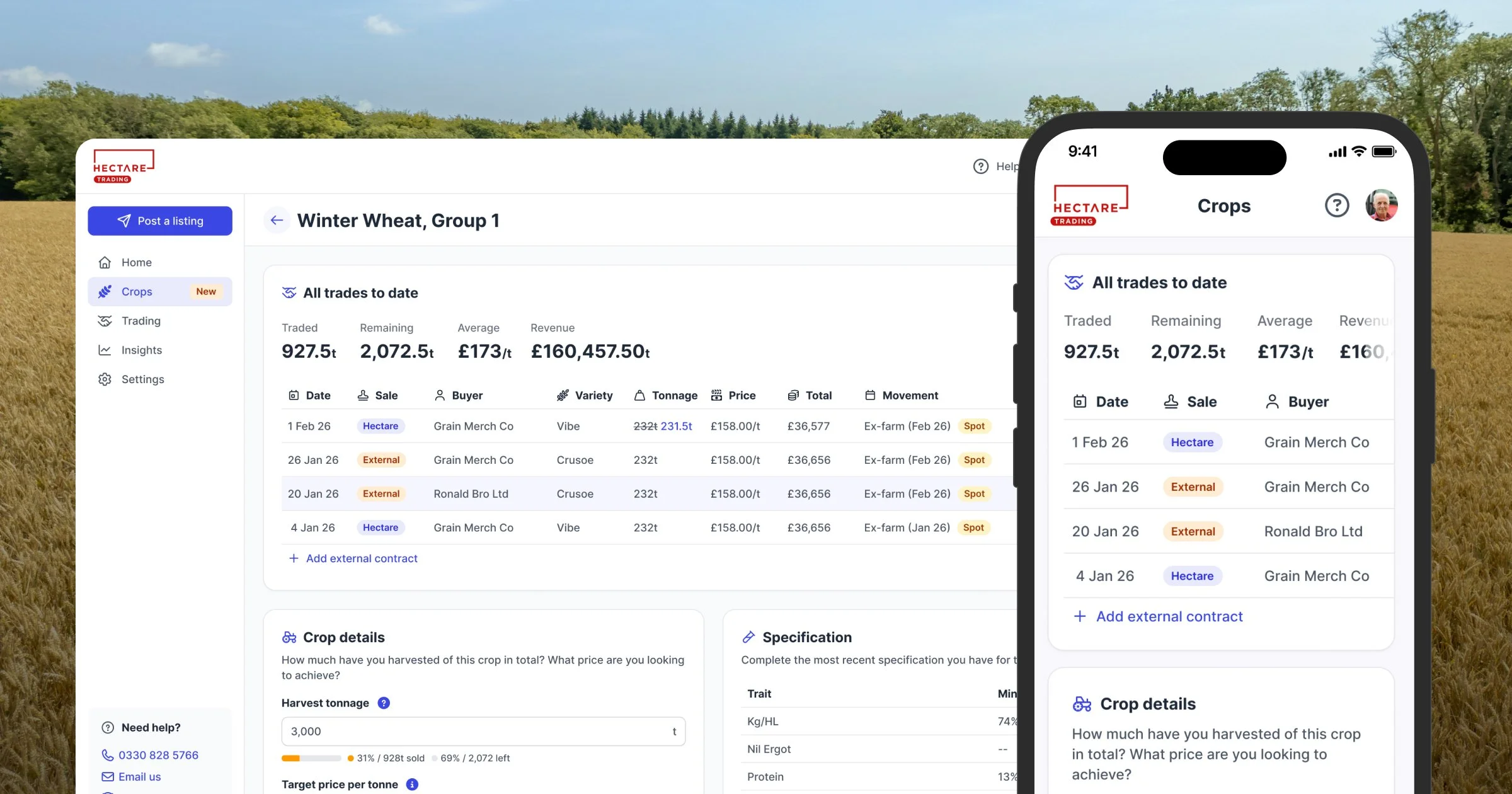
Track your sales progress with the Crops dashboard – for each crop and harvest year
Contracts for forward-selling
Selling your 2026 crop on Hectare Trading is straightforward. Select 2026 as your harvest year, then choose your preferred movement window from July onwards.
You can choose a fixed contract to lock in a single fixed price now, or a base contract to secure a base price with the option to achieve a premium once final spec is confirmed.
For quality grain, you can also choose a premium-only contract, allowing you to lock in premiums now and fix the base price later.
For oilseed rape, you now have two options:
Base contract (excluding oil bonus) – remember to factor the oil bonus (typically 1.5% of the base price for every 1% oil content above 40%) into your budget
Fixed contract (including oil bonus) – the offer price includes both base price and bonus, so make sure you check the bonus conditions in the notes
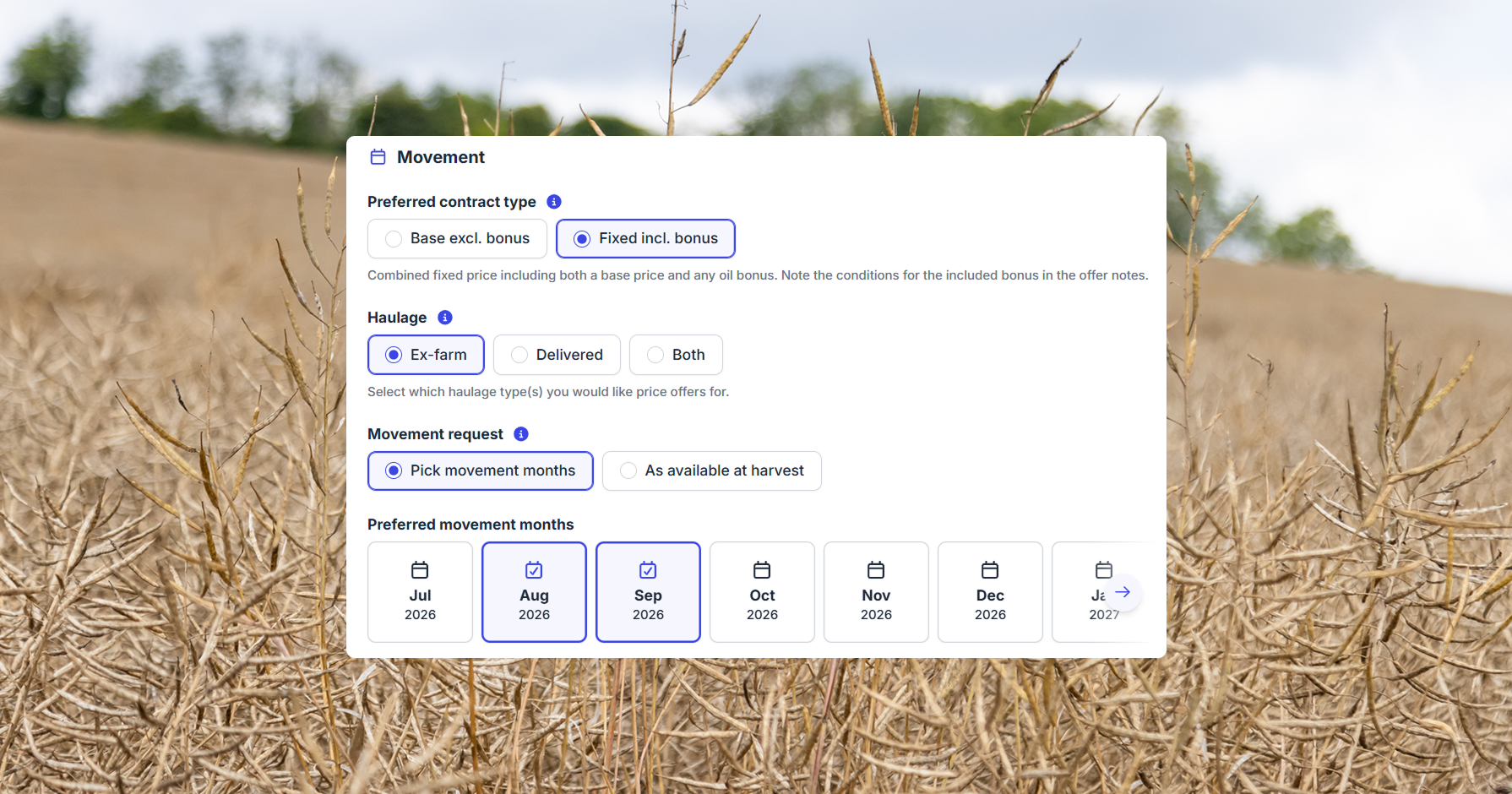
Your preferred contract for selling OSR – including or excluding the oil bonus
Stay flexible in harvest 2026
March to May is often a key window. As we’ve seen in previous articles, prices don’t always hold into harvest – and by then, your focus is rightly on getting the crop in.
You don’t need to make a big call against the market. But some strategic selling of your 2026 crop now could put you in a much stronger – and more flexible – position later in the year.
Looking to sell your 2026 crop or trying to clear your stores of old crop? Post a free listing and see what buyers are willing to pay in your region.
This article is for general information only and does not constitute advice. While we make every effort to ensure the accuracy of the content at the time of publication, Hectare Trading makes no guarantee regarding the data provided.