
How to get the best value from stored grain
3-MINUTE READ
Stored grain only adds value if the market is paying you enough to cover the cost of waiting to sell. Treat storage as part of your marketing strategy – whether the grain is in your own shed, a commercial store or a co-op.
Grain storage is a financial tool, and your choice to store or sell is always a marketing decision, not just a logistics decision.
Know what your storage is really costing you
Once you’ve invested in on-farm storage, it can be tempting to think of it as “free”. But every tonne you hold still has a cost attached to it.
There are the obvious costs: drying, electricity, handling, ventilation, pest control and maintenance. Then there is the cost of having money tied up in grain rather than available to reduce borrowing or put to work elsewhere.
Put these together and calculate your storage cost per tonne per month. This gives you a hurdle rate: the minimum monthly price increase you need to break even from holding the crop.
For example, if your total cost is £0.60/t per month, a forward price needs to offer more than £0.60/t per month above the spot price to make storage worthwhile.
The carry calculation
Carry is the premium the market offers for delivering your grain later.
Suppose you can sell feed wheat in your region today for £214/t ex-farm for immediate movement, but the market is also offering you £222/t for January movement.
That’s £8/t of carry over four months, or £2/t per month.
If your hurdle rate is £0.60/t per month, you’re left with a potential net return of £1.40/t per month for holding the grain.
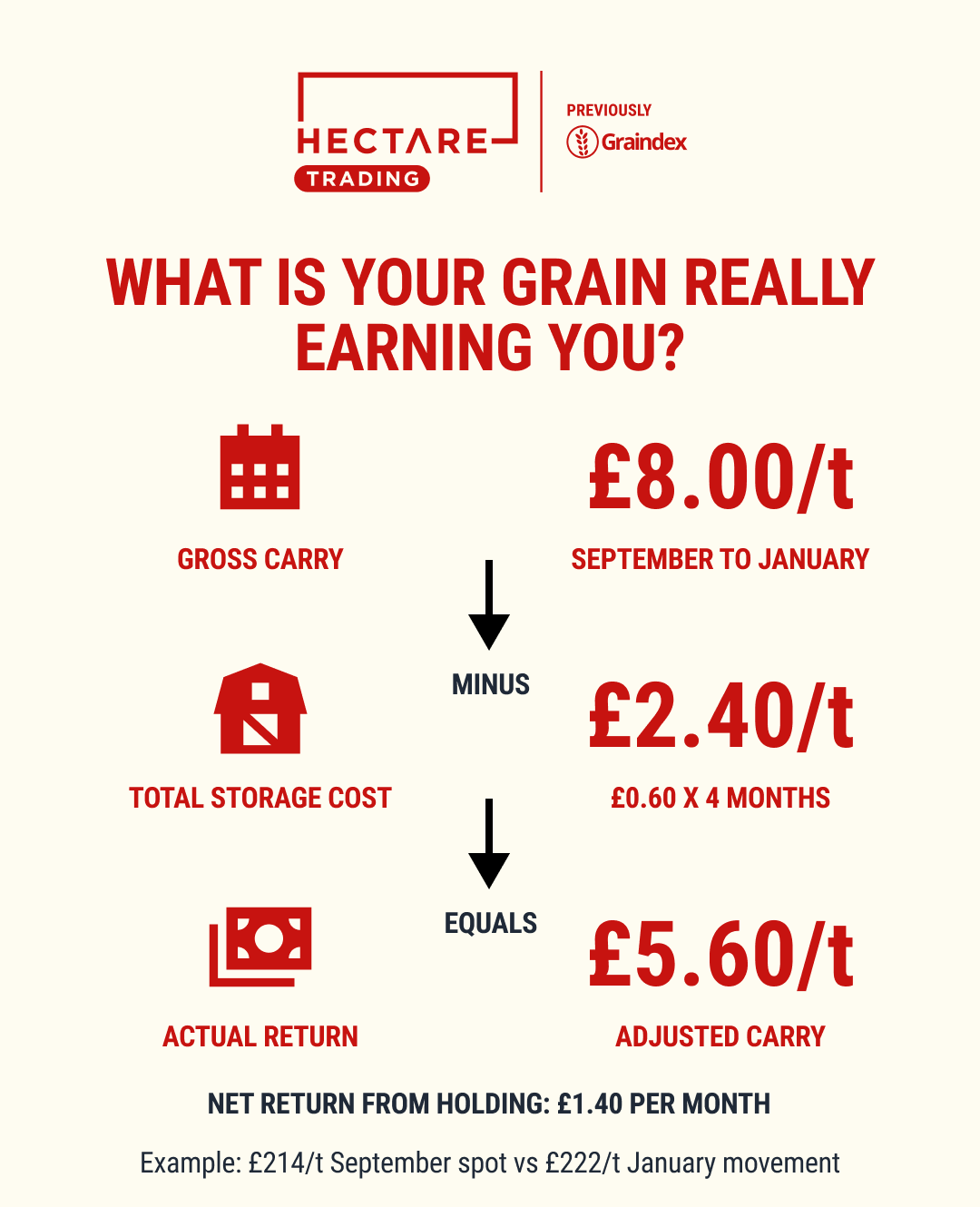
Gross carry vs actual return: in this example, an £8 carry becomes a return of £5.60
The important point is that the £8/t increase isn’t all profit. You need to deduct the cost of keeping the grain.
Also, compare like-for-like prices. Location, specification and haulage can make a significant difference to the real value of a forward offer.
By comparing real-time bids on Hectare Trading, and posting your own listings, you can make sure you’re using realistic prices as a benchmark for your storage decisions.
Don’t sleepwalk into Christmas
September is a good time to make a plan for the grain still in store.
If you know you need to clear space, don’t leave the decision until December. Quality crops such as milling wheat and malting barley can be particularly exposed if demand for spot tonnes weakens as buyers have already covered their requirements.
There are practical considerations too. Haulage becomes harder to arrange, stores and intake facilities can become congested, and the Christmas shutdown can quickly turn a straightforward sale into a logistical headache.
If you don’t want to carry grain through the winter, look at forward movement now rather than hoping the spot market will bail you out later.
Could a co-op work for you?
On-farm storage isn’t the only way to benefit from carry.
For some farms, a co-operative or central store can provide an efficient way to handle grain, with known storage and handling costs and access to larger-scale facilities. It can also separate the physical decision – where to store the grain – from the marketing decision – when and where to sell it.
Camgrain is a good example. Its members can use central storage and different marketing routes, including selling grain ex-store through Hectare Trading.
This gives farmers access to the open market and control over when to sell – while using the co-op to help manage the physical side of storing the crop.
A blended strategy
Storage versus selling doesn’t have to be an all-or-nothing decision.
A sensible approach could be to:
Spot-sell some grain now, generating cash and creating space
Forward-sell a portion, locking in an attractive carry and future income
Retain a portion, giving you the flexibility to respond if prices rise or a local premium appears
The right split will be different for every farm. But make this decision deliberately, rather than simply leaving grain in the shed because you’re waiting for a better price.
If you fail to lock in a forward price, you could end up bearing the costs of storage without the benefit of carry – if the spot price fails to rise when you eventually come to sell.
Remember, stored grain isn’t automatically more valuable. Your shed is only earning its keep when the extra value you get from waiting outweighs the cost of doing so.
Got grain to sell? Post a free crop listing and see what buyers in your region are paying for immediate and future movement.
This article is for general information only and does not constitute advice. While we make every effort to ensure the accuracy of the content at the time of publication, Hectare Trading makes no guarantee regarding the data provided.