
Why waiting until harvest isn’t really a marketing strategy
2-MINUTE READ
For many growers, waiting until harvest to market grain can feel like the safest option – especially in the current season shaped by dry weather, uncertain yields and the prospect of an early harvest.
But while “wait and see” may feel like a low-risk approach, it can leave you open to sudden market moves with very little flexibility.
Every harvest brings the same pressures: stores need emptying, cash flow matters, haulage tightens and large volumes of grain hit the market at once. That often shifts negotiating power towards buyers, particularly when growers need to move tonnage quickly.
Even in years where overall supply looks tighter, nearby harvest movement can still weigh on local prices. Which is why relying entirely on selling at harvest is often not really a strategy at all – you are simply reacting to pressure once it arrives.
Fundamentally, the longer you wait, the less control you have over the price you take. A more active approach gives you more command of your price.
Proactive grain marketing: selling forward
One of the biggest misconceptions around forward-selling is that it requires certainty. It doesn’t.
Selling a portion of your new crop before harvest is rarely an attempt to outguess the market or perfectly predict yields. More often, it helps to manage risk and create opportunities.
Markets are constantly reacting to weather forecasts, global production estimates, currency movements and wider economic uncertainty. Trying to consistently pick the highest point is incredibly difficult – even for professional traders.
That’s why many successful grain marketing approaches focus less on finding the perfect price and more on building averages over time.
Selling smaller percentages incrementally reduces your exposure to market swings while still leaving flexibility if conditions change later.
By choosing the right contract type you can also handle uncertainty over your final spec. For quality grain, select a base contract to agree a feed base price only, not including premiums. That way you can lock in your base price in advance while managing your spec risk.
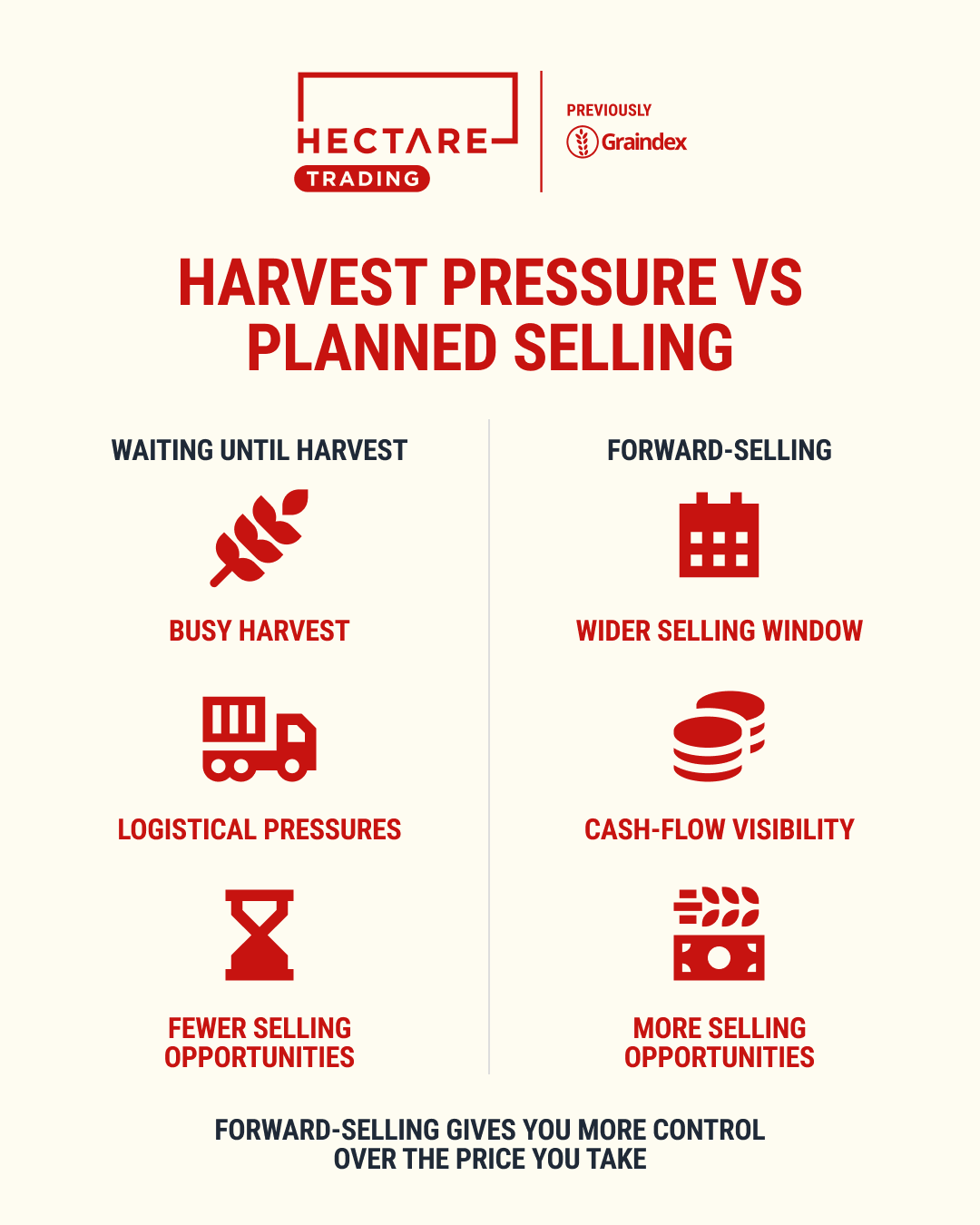
Selling your new crop forward in advance can relieve pressure at harvest
Planning ahead creates options
One advantage of making some sales before harvest is that it gives you more breathing space when harvest actually arrives.
If a proportion of tonnage is already committed:
Storage decisions become easier
Cash flow is more apparent
Harvest logistics become less pressured
Marketing becomes more measured rather than reactive
Importantly, forward-selling also widens the selling window. Instead of being forced to market grain during the busiest period of the year, growers who have planned ahead are often better placed to respond calmly to later opportunities.
Uncertainty cuts both ways
Current crop concerns are understandable. Dry weather has created nervousness around yield potential in many regions, and few growers want to oversell in an uncertain season.
But uncertainty does not automatically mean prices rise.
Markets have already factored some weather risk into values, and the global supply picture can change quickly. Rain arriving at the right time – either in the UK or elsewhere – can rapidly alter sentiment.
Hence the importance of a structured approach. For some farms, that may mean selling modest percentages at set price targets. For others, it could involve separating likely tonnage from “bonus” yield potential and marketing accordingly.
The key point is that forward-selling does not need to be all or nothing.
A good strategy reduces stress
Waiting until harvest may feel comfortable in uncertain conditions but, over the long term, a clear strategy will do more to relieve stress from your grain marketing.
A structured plan – even a simple one – helps remove emotion from decision-making. And a little proactive selling of your 2026 crop now can reduce the pressure that often builds once combines start moving.
Whether you want to sell a portion of your new crop, or clear your stores of old crop, post a listing today to see what price you can get for your grain.
This article is for general information only and does not constitute advice. While we make every effort to ensure the accuracy of the content at the time of publication, Hectare Trading makes no guarantee regarding the data provided.